
Many businesses publish blog posts, social media updates, and website pages without a clear plan. They stay active for a few months, see little traffic, and conclude that content marketing does not work.
The real problem is usually not content. It is the lack of strategy behind it.
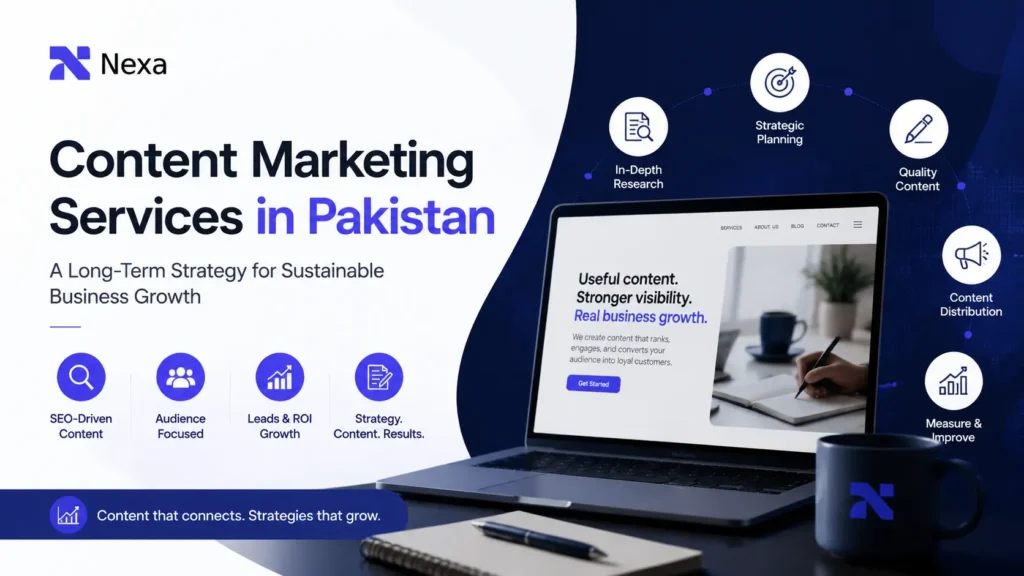
Professional Content marketing services in Pakistan connect every article, video, landing page, and social post to a business goal. Instead of producing random material, the business builds useful content that attracts the right audience, answers buying questions, earns search visibility, and supports sales over time.
Content marketing is not a quick traffic trick. It is a system for creating digital assets that can continue bringing value long after they are published.
What Are Content Marketing Services?
Content marketing services involve planning, creating, improving, publishing, distributing, and measuring content that supports business growth.
A complete service normally includes:
- Audience and competitor research
- Content strategy development
- Keyword and search intent research
- Website and blog content writing
- SEO content optimization
- Content calendars
- Landing pages and lead magnets
- Social media content
- Email content
- Content distribution
- Performance tracking
- Existing content updates
The goal is not simply to fill a website with articles. Each piece should have a clear purpose within the content marketing funnel.
Some content introduces the business to new audiences. Other content helps potential customers compare options, solve problems, or decide whether to request a quote.
Why Random Content Rarely Produces Business Growth
A company may publish regularly and still receive little return. This often happens because its content is not connected to customer demand.
Common problems include:
- Writing about topics customers do not search for
- Targeting highly competitive keywords without enough authority
- Publishing content without a defined audience
- Focusing only on traffic instead of qualified leads
- Creating articles that do not support services or products
- Ignoring content promotion after publication
- Measuring page views but not enquiries or sales
- Producing several articles that compete for the same keyword
For example, a software company may publish general technology news because those topics appear popular. The articles may attract visitors, but most of those visitors are not looking for software development services.
A better approach would focus on real customer questions, such as development costs, project timelines, technology choices, security concerns, and vendor comparisons.
The difference is commercial relevance.
Content Marketing vs Digital Marketing
Content marketing and digital marketing are related, but they are not the same.
Digital marketing is a broad category that includes SEO, paid advertising, email, social media, conversion optimization, and other online channels. Content marketing is one part of that larger system.
| Area | Content Marketing | Digital Marketing |
| Main focus | Educating and influencing an audience | Promoting a business through online channels |
| Common formats | Blogs, videos, guides, case studies and emails | SEO, PPC, social media, email and websites |
| Typical result | Trust, organic traffic and informed leads | Traffic, visibility, enquiries and sales |
| Time frame | Usually long term | Can include short- and long-term campaigns |
| Media type | Mostly owned content | Owned, paid and earned media |
A strong digital marketing strategy needs content.
SEO needs useful pages to rank. Social media needs posts to publish. Email marketing needs valuable messages. Paid campaigns need landing pages and persuasive copy.
Content provides the material that makes these channels work.
Content Marketing vs Social Media Marketing
Social media marketing focuses on reaching and engaging people through platforms such as Facebook, Instagram, LinkedIn, TikTok, and YouTube.
Content marketing has a wider role. It may include social media, but it also covers blog posts, website pages, email sequences, case studies, reports, videos, and downloadable resources.
Social posts often have a short lifespan. A useful blog post can attract search traffic for months or years when it is maintained properly.
The two channels work best together:
- A detailed blog post answers an important customer question.
- Key ideas from the post become social media updates.
- A short video explains one important point.
- An email shares the article with existing leads.
- Sales teams use the article when answering prospects.
This content repurposing strategy increases the value of every strong idea without copying the same message everywhere.
Why Content Marketing Supports Sustainable Growth
Paid advertising can produce traffic quickly, but that traffic normally slows when the advertising budget stops.
Content works differently. A useful article, service page, video, or comparison can remain discoverable after the original production cost has been paid.
It builds search visibility
Well-planned content helps a website cover the topics that matter to its customers. Over time, connected articles can strengthen the site’s relevance around its main services.
It builds trust before the sales call
Many customers research a company before contacting it. They compare prices, processes, risks, alternatives, and expected results.
Helpful content lets a business answer those concerns before a salesperson becomes involved.
It supports better-quality leads
A visitor who has read a detailed service comparison or pricing explanation often understands the offer better than someone who clicked a short advertisement.
That can result in:
- More informed enquiries
- Fewer unsuitable leads
- Better sales conversations
- Shorter explanations during calls
- Stronger confidence in the provider
It creates reusable business assets
A detailed case study can support sales calls, proposals, email campaigns, social media, and website conversions.
Good content is not only a marketing expense. It becomes part of the company’s sales infrastructure.
How to Create a Content Marketing Strategy
A successful strategy begins with customer needs, not a list of keywords.
1. Define the business outcome
Choose the main result the content should support.
Possible goals include:
- Increasing qualified website traffic
- Generating service enquiries
- Growing ecommerce sales
- Building an email list
- Educating existing customers
- Supporting a new product launch
- Entering a new market
- Reducing repeated sales questions
Avoid using “publish more content” as the goal. Publishing is an activity, not a business outcome.
2. Build a buyer persona
A useful buyer persona for a small business should describe a real buying situation rather than a fictional profile filled with unnecessary details.
Focus on questions such as:
- What problem is the customer trying to solve?
- What triggers the search for help?
- What concerns delay the decision?
- Who approves the purchase?
- What alternatives are being considered?
- Which proof builds confidence?
- What would make the customer reject a provider?
A business selling accounting software may target company owners, finance managers, and accountants. Each audience has different concerns, even when they are considering the same product.
3. Map the customer journey
Customer journey mapping identifies what people need at each stage of the buying process.
| Funnel stage | Customer need | Suitable content |
| Awareness | Understand the problem | Educational blogs, videos and checklists |
| Consideration | Compare possible solutions | Comparisons, detailed guides and webinars |
| Decision | Select a provider | Case studies, service pages, pricing information and FAQs |
| Retention | Get more value after purchase | Tutorials, email tips and support resources |
A balanced strategy covers the whole journey. A blog that only publishes introductory topics may attract traffic without moving readers toward a business decision.
4. Review existing content
A content audit checklist should review more than spelling and formatting.
Assess:
- Organic traffic
- Search impressions
- Keyword rankings
- User engagement
- Conversions
- Content accuracy
- Internal links
- Search intent
- Duplicate or overlapping topics
- Outdated statistics
- Weak calls to action
Some pages need rewriting. Others only need better examples, improved headings, fresher information, or stronger internal links.
Deleting everything and starting again is rarely the best first move.
5. Complete a content gap analysis
A content gap analysis compares customer questions with the information currently available on the website.
It can reveal:
- Important topics the website does not cover
- Questions competitors answer more clearly
- Missing funnel stages
- Weak product or service support content
- Opportunities for local examples
- High-value topics with poor existing search results
Competitor content should provide direction, not a template to copy. The strongest opportunity is often a topic that competitors cover poorly rather than one they ignore completely.
6. Build topic clusters
Topic clusters for SEO connect a central page with supporting articles.
For a content marketing service, a cluster might include:
- How content marketing works
- Content marketing costs
- Content marketing and SEO
- Small-business content planning
- B2B lead generation
- Ecommerce content
- Content performance measurement
- Agency selection
Each supporting article answers a focused question and links naturally to the central service page.
This structure helps readers move between related information. It also prevents the blog from becoming a collection of unrelated posts.
7. Create a practical content calendar
A content calendar for a small business should match its real production capacity.
A useful calendar includes:
- Topic
- Primary search intent
- Funnel stage
- Content format
- Target audience
- Writer or owner
- Publication date
- Internal links
- Distribution channels
- Update date
- Conversion goal
Publishing one high-quality article each week is often more useful than committing to daily content that the team cannot research, review, or promote properly.
Consistency matters, but quality control matters more.
How Content Marketing Helps SEO
Search engines need relevant, accessible, and useful pages to show users.
Content supports SEO by helping a website:
- Answer more customer questions
- Target relevant search topics
- earn internal and external links
- Cover services in greater depth
- Match different search intents
- Keep important pages current
- Build relationships between related topics
Google’s current guidance continues to prioritize helpful, reliable, people-first content. It also recommends original information, substantial coverage, useful analysis, and value beyond what already appears in search results.
Effective SEO content writing best practices include:
- Giving the reader a clear answer early
- Covering the topic with useful depth
- Using descriptive headings
- Adding practical examples
- Linking to relevant internal pages
- Supporting claims with reliable sources
- Writing natural titles and descriptions
- Updating content when information changes
- Avoiding unnecessary keyword repetition
Keywords still provide context, but repeating the same phrase does not make weak content more valuable.
What Helps Content Appear in AI Search Results?
There is no guaranteed method for appearing in an AI-generated answer.
Google’s current guidance says that its generative search features still rely on core Search ranking and quality systems. It recommends unique, expert-led, non-commodity content instead of special “AI SEO” tricks. Pages must also be crawlable and eligible to appear in regular search results.
Content becomes more useful to search engines and AI systems when it includes:
- Clear definitions
- Direct answers to specific questions
- Original examples
- First-hand observations
- Accurate process details
- Useful comparisons
- Decision criteria
- Supporting evidence
- Clear authorship
- Logical page structure
A generic article that repeats common advice gives an AI system little reason to cite it.
A page becomes more source-worthy when it contains details that are difficult to find elsewhere, such as:
- Real customer objections
- Local market conditions
- Pricing factors
- Process breakdowns
- Mistakes found during audits
- Before-and-after examples
- Performance lessons
- Industry-specific trade-offs
Article structured data can also help Google understand information such as the headline, author, images, and publication dates. It does not guarantee rankings, but it can improve how the page is understood and presented.
Types of Content Marketing for Small Businesses
The best format depends on the customer’s question and the business model.
| Content type | Main benefit | Suitable use |
| Blog posts | Attract informational searches | Education, tips and problem-solving |
| Service pages | Explain offers clearly | Commercial and buying searches |
| Case studies | Provide proof and context | Sales support and decision-stage leads |
| Videos | Make complex ideas easier | Tutorials, demonstrations and awareness |
| Email content | Nurture existing contacts | Follow-ups, education and offers |
| Comparison pages | Support decisions | Product, service or provider comparisons |
| Checklists | Provide quick practical value | Lead magnets and awareness content |
| Reports | Build authority | B2B research and industry insight |
| FAQs | Address common objections | Service pages and decision support |
| Product guides | Improve shopping decisions | Ecommerce category and product support |
The format should follow the user’s need.
A video is useful when a process needs to be demonstrated. A comparison table is better when a buyer is choosing between options. A case study is stronger when the customer needs evidence that a service can work in a similar situation.
Content Marketing for Ecommerce Businesses
An effective ecommerce content marketing strategy supports product discovery and customer confidence.
Useful ecommerce content includes:
- Buying guides
- Product comparisons
- Category guides
- Size or usage guides
- Product demonstration videos
- Customer questions
- Maintenance advice
- Seasonal content
- Gift guides
- Post-purchase email tips
For example, an online skincare store should not rely only on product descriptions. It can also publish content about skin types, ingredient differences, routines, application order, seasonal care, and product selection.
The content answers questions customers normally ask before buying.
Content Marketing for B2B Companies
A B2B content marketing strategy often needs to support longer buying cycles and several decision-makers.
A company may need approval from technical, financial, operational, and senior management teams. Each person evaluates the purchase differently.
Useful B2B formats include:
- Detailed service guides
- Process explanations
- Industry reports
- Case studies
- Implementation checklists
- Cost comparisons
- ROI calculators
- Webinars
- Email sequences
- Technical FAQs
A company choosing business software may care about security, integration, staff training, support, implementation time, and total ownership cost.
An effective strategy gives each stakeholder the information needed to move forward.
How to Generate Leads With Content Marketing
Traffic alone does not create business growth. The page must provide a logical next step.
A simple lead-generation path may look like this:
- A customer searches for a problem.
- An educational article provides a useful answer.
- The article links to a deeper comparison or checklist.
- The visitor sees a relevant service or solution.
- A clear call to action invites an enquiry.
- Email or sales follow-up supports the decision.
This process works best when the call to action matches the content.
An introductory article may offer:
- A checklist
- A newsletter
- A related resource
- A free website assessment
A decision-stage article may invite the reader to:
- Request a quote
- Book a consultation
- Review a service package
- Discuss a specific project
A good lead nurturing strategy continues helping the prospect instead of sending immediate sales messages after every download.
How Much Does Content Marketing Cost in Pakistan?
The content marketing cost in Pakistan depends on the amount of research, expertise, strategy, production, design, promotion, and reporting involved.
The price may be affected by:
- Number of articles or content pieces
- Topic complexity
- Required subject expertise
- Research depth
- Content length
- Graphic design or video production
- SEO research
- Editing and quality review
- Publishing support
- Distribution
- Reporting
- Content updates
- Number of target markets or languages
Cheap content can become expensive when it attracts the wrong audience, contains inaccurate information, damages trust, or needs to be completely rewritten.
Businesses comparing content marketing packages in Pakistan should examine the deliverables rather than choosing only by article count.
A basic package may focus on production. A stronger growth package may include research, strategy, internal linking, content updates, distribution, and conversion tracking.
Ask what happens before and after the writing. Strategy and measurement often create the difference between content output and business impact.
How to Measure Content Marketing ROI
Content performance should be measured against its intended role.
Useful content marketing KPIs include:
Visibility metrics
- Search impressions
- Keyword rankings
- Organic traffic
- Referral traffic
- Brand searches
Engagement metrics
- Engaged sessions
- Scroll depth
- Video views
- Downloads
- Return visitors
Lead metrics
- Enquiry form submissions
- Calls
- Email sign-ups
- Qualified leads
- Cost per lead
Revenue metrics
- Sales influenced by content
- Customer acquisition cost
- Conversion rate
- Revenue from organic traffic
- Customer lifetime value
A simple ROI calculation is:
Content ROI = (Return from content − content investment) ÷ content investment × 100
Suppose a campaign costs PKR 250,000 and produces PKR 500,000 in attributable gross profit.
The calculation would be:
(PKR 500,000 − PKR 250,000) ÷ PKR 250,000 × 100 = 100% ROI
Attribution is not always direct. A customer may read several articles, return through Google, view a case study, and contact the company later.
That is why businesses should review assisted conversions and sales feedback instead of crediting only the final click.
Common Content Marketing Mistakes
Publishing without distribution
An article should not be considered finished when it goes live.
A content distribution strategy may include:
- Email newsletters
- Industry communities
- Sales outreach
- Internal linking
- Relevant partnerships
- Video or visual repurposing
Distribution should be selective. Sharing every post on every platform creates activity, but not necessarily results.
Targeting only high-volume keywords
Large search volume does not always mean high business value.
A lower-volume keyword about service costs or vendor selection may produce fewer visitors but more qualified enquiries.
Copying competitor structures
Competitor research can show what users expect, but copying headings and examples produces interchangeable content.
The business needs a distinct contribution.
Ignoring older articles
Search demand, competitors, products, and customer questions change.
Updating an existing article can sometimes produce better results than publishing another similar post.
Treating every visitor as ready to buy
Most informational visitors are not ready to request a quote immediately.
Helpful internal links and light calls to action give them a reason to continue without creating pressure.
How to Choose a Content Marketing Agency in Pakistan
The right agency should understand more than writing.
Before selecting a provider, ask:
- How will you research our customers and competitors?
- How will you connect content topics to our services?
- How do you prevent keyword cannibalization?
- Who writes and reviews technical content?
- How do you verify claims and sources?
- What is included in the content brief?
- How will content be distributed?
- Which performance metrics will be reported?
- How often will older content be reviewed?
- Can you show relevant examples or explain the process behind previous work?
Look closely at the agency’s sample work.
Strong content should show:
- Clear search intent
- Logical structure
- Industry understanding
- Useful examples
- Natural keyword use
- Accurate information
- Relevant calls to action
- A clear connection to business goals
Avoid providers that promise guaranteed rankings or immediate results. Search performance depends on competition, website authority, technical health, content quality, links, user demand, and many other factors.
A Long-Term Content Marketing Timeline
Content marketing usually develops in stages.
Months 1–3: Build the foundation
Typical work includes:
- Customer research
- Content audit
- Keyword mapping
- Competitor analysis
- Funnel planning
- Editorial calendar
- Initial priority pages
Months 3–6: Build coverage
The focus moves toward:
- Publishing topic clusters
- Improving internal links
- Updating existing pages
- Distributing content
- Reviewing early search data
- Strengthening weak pages
Months 6–12: Improve performance
The team can use collected data to:
- Refresh promising articles
- Improve conversion paths
- Expand successful topics
- Remove content overlap
- Create case studies
- Strengthen lead nurturing
- Adjust the strategy around real enquiries
Results may appear earlier or later depending on the starting position. A new website in a competitive market normally faces different conditions from an established business with strong authority.
Turn Content Into a Business Growth System
Sustainable content marketing is built on useful information, consistent execution, and commercial focus.
The strongest strategy does not chase every trending topic. It answers the right questions for the right audience and creates a clear path from discovery to trust and action.
Businesses considering content marketing services in Pakistan should look for a partner that can connect audience research, SEO, production, distribution, and measurement.
Nexa Digital Marketing helps businesses create content strategies designed around customer intent and long-term growth. Talk to the team about a content audit or a practical plan for your website.
Frequently Asked Questions
1. Is content marketing suitable for a small business?
Yes. A focused content marketing strategy for a small business can target specific customer questions without requiring a large publishing team. Start with a few high-value topics connected to your main services or products.
2. How long does content marketing take to work?
The timeline depends on the website’s current authority, competition, technical condition, content quality, and distribution. Some pages may gain visibility within weeks, while competitive topics can require several months of consistent work.
3. How often should a business publish blog content?
Choose a schedule that allows proper research, writing, review, optimization, and promotion. One strong article per week or every two weeks can be more valuable than several rushed posts.
4. Does content marketing replace paid advertising?
No. Content marketing and paid advertising serve different purposes. Paid ads can produce faster visibility, while content can build organic discovery and trust over time. Many businesses use both.
5. What should be included in a blog content strategy for SEO?
A strong blog content strategy for SEO should include audience research, search intent, topic clusters, keyword mapping, internal linking, content briefs, publishing schedules, distribution, updates, and performance measurement.
6. Can content marketing generate sales directly?
Yes, especially when content targets comparison, pricing, product, and service-related questions. Informational content may influence a sale indirectly by building trust and helping customers understand their options.
7. Should a company hire an agency or build an internal team?
An internal team offers close access to company knowledge. An agency may provide broader SEO, writing, design, and strategy skills. Some businesses use a hybrid model where internal experts supply knowledge and an agency manages research, production, optimization, and distribution.