
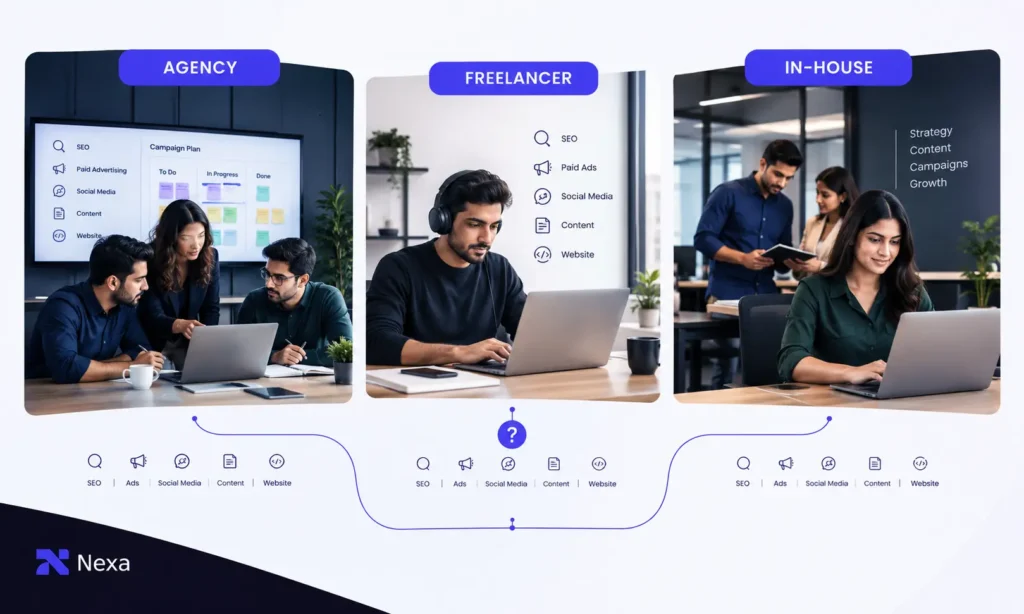
Choosing between a digital marketing agency, a freelancer, and an in-house marketing team can be difficult for a business in Pakistan. Each option offers different levels of expertise, control, flexibility, and cost.
The right choice depends on what your business needs, how much work must be done, and who will manage the marketing activities.
A freelancer can be a good choice when you need one specialist or help with a clearly defined project. A digital marketing agency may suit businesses that need several marketing skills working together. An in-house marketer or team can make sense when marketing requires regular attention, close coordination with other departments, and a deep understanding of the business.
Some companies also combine these options. For example, an internal marketing manager can oversee strategy while external specialists handle SEO, advertising, or website development.
This guide compares the four approaches so you can decide based on your actual needs, not price alone.
Digital Marketing Agency vs Freelancer vs In-House: Key Differences
Before choosing an option, understand how each arrangement works.
| Factor | Digital Marketing Agency | Freelancer | In-House Marketer or Team |
| Team structure | A business working with a provider that may have several specialists | An independent professional, usually focused on specific skills | An employee or group of employees working within your business |
| Skills | Can provide several marketing disciplines, depending on the agency’s services | Usually strongest in selected areas of expertise | Depends on the employees hired and the team’s combined skills |
| Cost structure | Project fees, retainers, or other agreed service fees | Hourly, project-based, or recurring fees | Salaries and employment-related expenses, plus tools and training |
| Communication | Through agreed contacts and delivery processes | Usually direct communication with the person doing the work | Direct communication within the business |
| Control | Shared between the business and provider according to the agreement | Depends on the contract and working arrangement | Greater day-to-day operational control |
| Management effort | Requires clear goals, communication, and approvals | May require substantial coordination if multiple freelancers are involved | Requires hiring, management, training, and performance reviews |
| Specialist coverage | Depends on the services and expertise available | Usually limited by the individual’s skills and capacity | Depends on the skills and number of people hired |
| Availability | Depends on the service agreement and delivery capacity | Depends on the freelancer’s commitments and agreement | Depends on employment arrangements and team capacity |
| Scalability | Scope can sometimes expand by adding services or resources | Capacity may be limited unless additional freelancers are coordinated | Growth often requires additional hiring, training, or restructuring |
| Best suited for | Businesses that need coordinated marketing services | Businesses with a defined task or specialist requirement | Businesses with regular workloads and a need for close internal involvement |
These are general differences, not guarantees. An experienced freelancer can outperform an unsuitable agency, and an in-house team can still struggle if it lacks the necessary skills, resources, or direction.
The important question is which arrangement can meet your requirements reliably.
1. Hiring a Digital Marketing Agency in Pakistan
A digital marketing agency provides agreed marketing services through a business-to-business arrangement. Depending on its service offering, it may support search engine optimisation, paid advertising, social media marketing, content creation, branding, or website development.
This option can be useful when your business needs multiple skills but does not want to recruit every specialist as an employee.
Advantages of a digital marketing agency
Access to different skills
Marketing often involves more than one activity. An SEO campaign may require technical website improvements, content planning, keyword research, and performance reporting.
An agency with the relevant specialists may coordinate these activities under an agreed scope of work.
Coordinated execution
When responsibilities are clearly defined, the provider can help align different marketing activities around shared business goals.
For example, a company may need landing pages, paid advertising, and conversion tracking to work together. Coordinating these tasks can be more complicated when each activity is managed independently.
Flexible service scope
Some agencies offer individual services, while others provide a broader range of support. This may allow a business to focus on its immediate needs and expand the scope later.
However, additional services should only be included when they are useful and within the agreed budget.
Defined reporting and responsibilities
A well-structured engagement should explain who is responsible for each task, what will be delivered, how progress will be reviewed, and which decisions require the client’s approval.
These details matter more than a provider’s label.
Limitations of a digital marketing agency
An agency may not be the best choice for every business.
Its fee can be difficult to justify when the business needs only one small, occasional task. Communication can also become frustrating if responsibilities, approval processes, or reporting expectations are unclear.
Not every agency provides every marketing discipline. You should confirm which work is handled directly, which services involve external specialists, and who is accountable for delivery.
An agency also needs input from the business. It cannot make every commercial decision without understanding the company’s products, customers, margins, and priorities.
When should you hire an agency?
Consider an agency when:
- Your marketing requires several connected skills.
- You need regular support rather than a single task.
- Recruiting and managing several specialists internally is not practical.
- You have clear business objectives but need external marketing execution.
- Your current arrangements lack coordination across channels.
Before signing an agreement, review the provider’s relevant work, scope, deliverables, reporting process, communication arrangements, and exit terms.
You can explore Nexa Digital Marketing’s Digital marketing services to see the service areas offered by the company.
2. Hiring a Digital Marketing Freelancer in Pakistan
A freelancer is an independent professional who provides services directly to clients. Depending on their specialisation, they may work on SEO, Google Ads, social media, graphic design, content writing, or another marketing discipline.
Hiring a freelancer can be practical when you know what work needs to be completed and can evaluate the person’s ability to deliver it.
Advantages of hiring a freelancer
Direct access to a specialist
You communicate with the professional responsible for the work. This can make feedback and task-specific discussions straightforward.
Suitable for defined projects
Freelancers can be useful for individual assignments, such as conducting an SEO audit, designing a set of social media graphics, writing website content, or setting up a campaign.
The work can be easier to evaluate when the deliverables and acceptance criteria are clear.
Flexible engagement
A business may hire a freelancer for a specific project or an agreed recurring workload without creating a permanent employee position.
The actual commitment depends on the agreement, availability, and project requirements.
Access to specialist expertise
A skilled freelancer can provide focused knowledge in an area where your business lacks experience. This may be especially useful when you already have someone internally who can manage strategy and coordinate the work.
Limitations of hiring a freelancer
The main limitation is the gap between a specialist’s skills and your total marketing needs.
For example, a skilled social media manager may not also be an experienced technical SEO specialist, advertising analyst, web developer, and brand strategist.
Hiring several freelancers can fill those gaps, but someone must coordinate the different assignments. Without clear ownership, work can become disconnected, and deadlines can be missed.
Availability is another consideration. A freelancer may have other clients, limited capacity, or planned time away. Discuss communication, deadlines, backup arrangements, and handover expectations before starting.
How to evaluate a digital marketing freelancer’s portfolio
Do not rely on a portfolio’s appearance alone. Assess whether the work demonstrates the skills your business requires.
Check the following:
- Relevance: Has the freelancer completed work similar to your project?
- Contribution: Can they explain their role in the work shown?
- Reasoning: Can they explain why they chose a particular approach?
- Evidence: Where results are claimed, can they provide appropriate supporting evidence?
- Communication: Do they understand the brief and explain decisions clearly?
- Capacity: Can they realistically complete the work within your required timeframe?
- Documentation: Will they provide files, reporting, and handover materials as agreed?
A portfolio is useful evidence, but it is not a complete guarantee of future performance.
When should you hire a freelancer?
A freelancer may be the better choice when:
- You need one clearly defined skill.
- Your project has a limited scope.
- You have someone internally who can manage the work.
- You need occasional specialist support.
- Your business is testing a particular marketing activity before expanding it.
For example, a business with an existing marketing manager might hire a freelancer for a technical SEO audit or a website content project. The internal manager remains responsible for deciding priorities and implementing the broader strategy.
3. Building an In-House Digital Marketing Team
An in-house marketing arrangement means hiring employees to work within your business. It can involve one marketing executive or a larger team with different areas of expertise.
This model gives the business closer day-to-day involvement in marketing decisions, but it also creates ongoing responsibilities for recruitment, management, and development.
Advantages of an in-house team
Closer understanding of the business
Employees can develop a detailed understanding of your products, customers, internal processes, brand guidelines, and commercial priorities.
This can be valuable when marketing decisions depend on frequent collaboration with sales, customer support, operations, or product teams.
Greater day-to-day control
The business can usually coordinate employees’ work, priorities, and internal meetings more directly than work performed by an external provider.
That control still needs clear objectives and effective management.
Consistent internal communication
An in-house marketer may have easier access to customer feedback, sales information, new product updates, and other internal knowledge.
This can help marketing stay aligned with the wider business.
Ongoing knowledge development
Employees can build knowledge of the business over time. Documented processes and shared access to work materials can help that knowledge remain available to the organisation.
Limitations of an in-house team
The cost of an employee extends beyond the advertised salary.
Depending on the arrangement, a business may also need to account for recruitment, onboarding, software, equipment, training, management time, and other employment-related expenses.
There is also a skills issue. One marketing employee should not automatically be expected to cover every discipline at a high level.
For example, an employee responsible for content and social media may not have the technical expertise needed to manage complex website issues or advanced paid advertising campaigns.
Hiring more people can address that gap, but it also increases the management and financial commitment.
In-house digital marketing roles and responsibilities
Before hiring, determine which responsibilities actually need to be covered.
| Role or function | Typical responsibilities |
| Marketing manager | Planning, priorities, budgets, coordination, and reporting |
| SEO specialist | Search visibility, website analysis, technical and on-page SEO, and content recommendations |
| Paid advertising specialist | Campaign setup, budget monitoring, testing, and performance analysis |
| Social media manager | Content planning, publishing coordination, audience engagement, and platform reporting |
| Content writer or strategist | Research, content planning, writing, editing, and content performance review |
| Designer or web developer | Visual assets, website improvements, landing pages, and technical implementation |
A small business may not need to hire someone for every role. Some responsibilities can be combined, outsourced, or handled by existing employees if they have the relevant skills and capacity.
When should you build an in-house team?
Consider this model when:
- Marketing work is continuous and substantial.
- The business needs frequent collaboration between marketing and other departments.
- Product knowledge and internal coordination are especially important.
- The business can support recruitment, management, training, and tools.
- Leadership wants direct involvement in ongoing marketing operations.
The key is to assess the actual workload before hiring, rather than building a team based on an ideal organisation chart.
4. Which Option Costs Less in Pakistan?
There is no reliable universal answer. A freelancer, agency, and in-house employee may offer very different services, levels of experience, and working arrangements.
Comparing headline fees alone can produce a misleading result.
For a wider overview of the factors affecting local digital marketing budgets, read Nexa’s guide to Digital marketing costs in Pakistan.
Compare the total cost, not just the fee
| Cost factor | Agency | Freelancer | In-house |
| Main payment | Agreed project fee or retainer | Agreed project fee, hourly rate, or recurring fee | Salary and applicable employment costs |
| Marketing tools | May be included or charged separately | May be included or charged separately | Often purchased or provided by the employer |
| Multiple skills | May be available within the agreed service scope | May require additional freelancers | May require multiple hires or external support |
| Management time | Briefing, approvals, communication, and reviews | Task assignment, coordination, and reviews | Supervision, meetings, recruitment, and performance management |
| Training and recruitment | Generally provider-side responsibilities for its own staff | Generally freelancer-side responsibilities | Business-side responsibilities |
| Advertising spend | Confirm separately | Confirm separately | Budgeted by the business |
For any model, confirm what the quote includes. Website hosting, software licences, content production, advertising spend, taxes where applicable, and third-party services may be treated differently across agreements.
Use this simple total-cost framework
Total cost = Provider fees or employment costs + tools and production expenses + advertising spend + management time + other applicable overheads.
This is a planning framework, not a formal accounting formula. Some items may not apply, and some may already be included in a provider’s fee.
For example, an agency’s fee may cover campaign management but exclude the money paid to the advertising platform. A freelancer’s fee may cover content production but exclude design or development work. An in-house employee may handle daily marketing while the business separately pays for specialist projects.
These are different arrangements, even if all three are described as digital marketing support.
To make a fair comparison, ask each provider to quote for the same deliverables, scope, reporting requirements, and timeframe.
A lower quote is not automatically better value if it omits essential work. Likewise, a higher fee is not proof of stronger expertise.
5. Agency vs Freelancer vs In-House: Which Is Best for Your Business?
The right model depends on your current workload, marketing needs, internal skills, and ability to manage execution.
The following scenarios are illustrative examples, not claims about particular businesses or guaranteed outcomes.
| Business situation | Model to consider | Why it may fit |
| A business needs a one-off SEO audit | Freelancer or specialist agency | The scope can be defined around a specific deliverable. |
| A small company needs SEO, paid advertising, and content support | Agency or hybrid model | Several disciplines may need coordination. |
| A business has a marketing manager but lacks technical expertise | Freelancer or agency for specialist tasks | Internal ownership remains in place while skill gaps are addressed. |
| A company has a steady stream of daily marketing work | In-house team or hybrid model | Internal staff can manage recurring priorities and work closely with other departments. |
| An eCommerce business needs internal product knowledge and specialist campaign execution | Hybrid model | Internal staff can manage product and commercial priorities while external specialists support defined activities. |
| A startup is testing whether a marketing channel suits its audience | Freelancer or a clearly scoped agency project | The business can define a limited scope before committing to a larger setup. |
A practical decision framework
Answer these six questions before choosing a model.
- How many different skills do you need?
If your main requirement is one specialist task, a freelancer may be enough. If you need several connected services, compare an agency and a hybrid arrangement.
- Is the workload occasional or continuous?
A one-off project usually requires a different commitment from a daily workload that needs ongoing attention.
- Who will manage the work?
A freelancer or agency still needs direction, feedback, approvals, and business context. If nobody can provide those inputs, clarify who will take responsibility before hiring.
- How much internal control do you need?
An in-house team may suit a business that needs frequent collaboration and direct daily oversight. External providers can still work closely with internal staff when communication and responsibilities are clearly defined.
- Can your business support the full cost?
Account for fees, employee expenses, tools, advertising budgets, additional specialists, and management time. Do not decide based on a monthly price alone.
- What happens if your needs change?
Consider how the arrangement would adapt if your business adds a service, changes its target audience, increases campaign activity, or needs new specialist skills.
Your answers should point towards a suitable working arrangement, rather than a universal winner.
6. When Does a Hybrid Marketing Team Make Sense?
A hybrid model combines internal responsibility with external specialist support.
For example, a business might have an internal marketing manager who understands its goals, customers, and sales process. That manager may work with a freelancer on content production and an agency on paid advertising or SEO, depending on the skills required.
This arrangement can provide internal knowledge and specialist support without requiring the business to hire every role.
However, a hybrid model also needs coordination.
Before adopting it, define:
- Who owns the overall strategy?
- Who assigns and approves work?
- Who manages the budget?
- Who is responsible for each marketing channel?
- Who owns the accounts, files, and reporting data?
- Who reviews performance and decides what to change?
- How will the team share updates and resolve conflicting priorities?
Without these arrangements, a hybrid setup can create duplicated work, unclear accountability, and unnecessary communication.
A hybrid model is worth considering when the business needs internal oversight but does not have every specialist capability in-house. It is not automatically cheaper or easier than choosing one provider.
7. Questions to Ask Before Hiring a Marketing Provider
Whether you hire an agency or freelancer, use a consistent evaluation process.
Questions about experience and skills
Ask for examples of relevant work and clarification of the person’s or team’s role in delivering it.
Ask how they would approach your particular requirements. A useful response should explain the reasoning and the information they would need, not simply promise results.
Questions about scope and deliverables
Confirm exactly what is included.
For example, an SEO engagement might cover audits, keyword research, on-page improvements, content recommendations, and reporting. It may not include website development, content writing, or every recommended technical change.
Similarly, a paid advertising agreement should clarify who manages the campaigns, who funds advertising spend, what is reported, and which activities fall outside the fee.
You can explore Nexa’s SEO services, Paid advertising services, and Social media marketing services for examples of different marketing service areas.
Questions about reporting and accountability
Agree on the business objectives, reporting frequency, metrics, and responsibilities before work begins.
Depending on the project, reporting may cover completed work, website traffic, relevant search performance, leads, conversions, campaign spend, or other measures connected to your goals.
Do not rely on a single metric without context. More traffic, for example, does not necessarily mean more qualified enquiries or sales.
Questions about ownership and access
Your agreement should establish appropriate access to important business assets.
Confirm the arrangements for:
- Advertising accounts and business platform access.
- Website administration and domain access.
- Analytics and reporting.
- Content, creative files, and campaign documentation.
- Access permissions when a provider leaves.
- Handover of files, outstanding tasks, and relevant records.
The exact arrangements depend on the services being provided, but ownership and access should not be left unclear.
Questions about communication and contracts
Ask who your main contact will be, how often you will communicate, what response times you can reasonably expect, and how approvals will work.
Check the contract’s scope, payment terms, changes to deliverables, cancellation arrangements, and handover responsibilities. Obtain professional advice where necessary before agreeing to material contractual commitments.
A clear agreement protects both parties by reducing misunderstandings about expectations.
8. Digital Marketing Agency Red Flags to Watch For
Be cautious when a provider:
- Guarantees specific rankings, leads, sales, or revenue without a sound basis.
- Cannot explain what its proposed work includes.
- Offers vague reporting without connecting activities to business goals.
- Avoids reasonable questions about relevant experience or responsibilities.
- Refuses to clarify access, ownership, or handover arrangements.
- Pushes services that do not match your current needs.
- Makes promises without understanding your business, customers, website, or objectives.
One warning sign alone does not always tell the whole story. Ask questions, verify relevant information, and assess the provider’s responses before making a decision.
A professional working relationship should include realistic expectations, clear responsibilities, transparent communication, and an agreed way to assess progress.
9. How to Build a Practical Digital Marketing Plan Before Hiring
You do not need to know every marketing tactic before speaking to a provider. However, a basic plan can make the hiring process more effective.
Start by defining the result you are trying to achieve. That might be more qualified enquiries, stronger search visibility, improved website performance, or a clearer content strategy.
Next, identify the activities that may support that goal. For example, a business seeking more organic search traffic may need technical SEO, useful content, and relevant website improvements. A business running paid campaigns may also need suitable landing pages and conversion tracking.
Then review your internal resources. Identify what your team can handle, where specialist support is needed, and who will manage the relationship.
Finally, create a short scope of work describing the priorities, deliverables, budget constraints, approval process, and reporting expectations.
Nexa’s guide to Digital marketing strategy in Pakistan can help you explore the planning side of this decision.
For smaller businesses, the Digital marketing guide for small businesses in Pakistan is another relevant resource.
The aim is to choose the right support for a defined business need, not to hire a provider before deciding what the business actually requires.
Final Verdict: Which Marketing Model Should You Choose?
The best choice is the one that matches your business requirements and can be managed effectively.
Choose a freelancer when you need a specific skill, a defined task, or occasional specialist support.
Choose a digital marketing agency when your requirements involve several related services, and you need a provider that can coordinate the agreed work.
Choose an in-house marketer or team when your business has a sustained workload, needs close internal collaboration, and can support the people and resources required.
Choose a hybrid model when you want internal ownership of marketing priorities but need external support for particular skills or activities.
Before making the decision, define your goals, compare equivalent scopes, calculate the full cost, and establish clear responsibilities. You should also agree on how progress will be reviewed and how access to your accounts, website, and marketing assets will be maintained.
If you are exploring external support, Nexa Digital Marketing offers services across SEO, paid advertising, social media marketing, content marketing, website design and development, and branding. Review the services that match your requirements, then decide whether external support, internal hiring, or a combination of both fits your business.
Visit the Nexa Digital Marketing contact page to discuss your needs and explore a suitable approach. The first step is understanding what your business requires, not committing to a particular model before assessing the options.
Frequently Asked Questions
1. Is a digital marketing agency better than a freelancer?
Not in every situation. An agency may be suitable when you need several marketing disciplines and coordinated execution. A freelancer may be more practical for one specialist task or a clearly defined project. Compare the relevant skills, scope, communication, and cost before deciding.
2. Is hiring a freelancer cheaper than hiring an agency in Pakistan?
It can be, particularly for limited work requiring one specialist. However, hiring several freelancers may introduce additional coordination costs and separate fees. Compare equivalent deliverables and the total cost of the arrangement rather than assuming that one option is always cheaper.
3. When should a business hire an in-house marketing team?
An in-house team may make sense when the workload is substantial and ongoing, internal collaboration is important, and the business can support recruitment, management, training, and tools. Assess the required roles and available workload before hiring.
4. Can a business use an agency and an in-house marketer together?
Yes. An internal marketer can oversee priorities, brand direction, and communication while external specialists handle defined tasks. This works best when ownership, responsibilities, reporting, and approvals are clear.
5. What should be included in a digital marketing agreement?
The agreement should explain the scope of work, deliverables, fees, payment terms, reporting, responsibilities, communication arrangements, account access, ownership of assets, and the process for changing or ending the engagement. The exact requirements depend on the work involved.
6. Should I hire one freelancer for SEO, advertising, and social media?
That depends on the individual’s actual skills and your needs. Some professionals have experience across several disciplines, but a broad list of services does not prove specialist ability in each one. Review relevant work, ask how each activity would be managed, and identify any skills gaps before committing.