
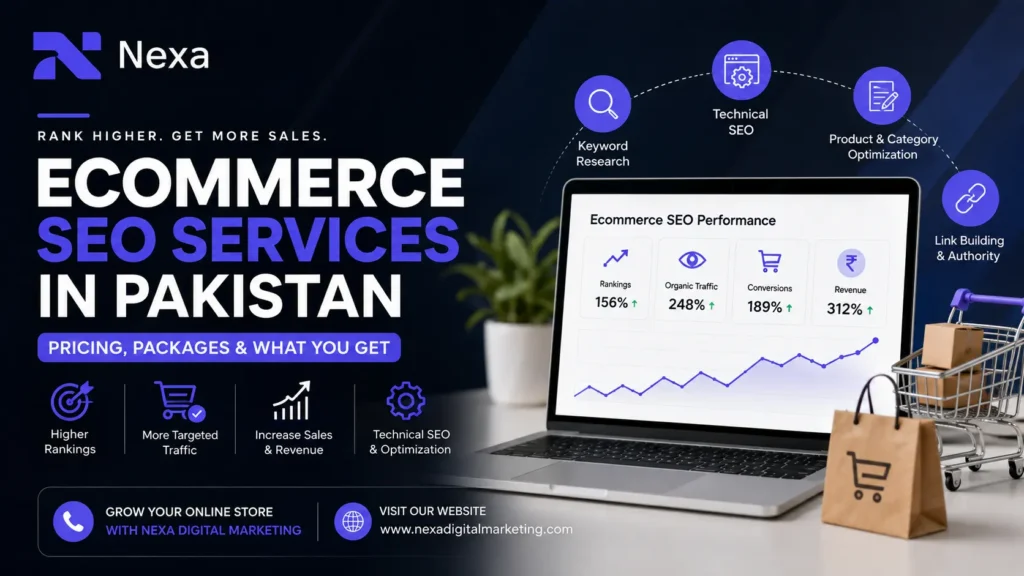
A well-built online store can still struggle to generate orders when customers cannot find its products on Google. For Pakistani ecommerce businesses, Ecommerce SEO Services in Pakistan can improve visibility across product pages, category pages, and other search journeys that bring shoppers closer to a purchase.
The bigger question is not simply whether SEO works. It is what ecommerce SEO should include, how much it should cost, and what a business should expect from an SEO package. The right service should cover technical health, keyword research, product and category optimization, internal linking, content, and ongoing measurement rather than focusing on rankings alone.
What Are Ecommerce SEO Services in Pakistan?
Ecommerce SEO services are a combination of technical, content, and authority-building activities designed to help an online store appear for relevant Google searches and turn organic visitors into customers. The work usually covers keyword research, site structure, product and category pages, technical SEO, content optimization, and performance tracking.
A strong ecommerce SEO campaign connects three things:
- Search visibility: helping Google understand and discover important pages.
- Buyer relevance: matching products and categories with the terms shoppers actually use.
- Conversion potential: making landing pages useful enough to support a buying decision.
Google recommends making ecommerce content, product data, and site structure clear so search engines can better understand and surface products across Google Search and other surfaces.
For businesses operating in Pakistan, that can mean optimizing around local search behavior, product terminology, pricing expectations, delivery areas, and the way customers compare products before ordering.
What Does an Ecommerce SEO Package Include?
A useful ecommerce SEO package should cover the full shopping journey, from discovering a search term to landing on a product page and moving toward checkout. The exact scope should change according to the store’s platform, catalog size, competition, technical condition, and business goals.
| SEO area | What is typically included | Why it matters |
| Keyword research | Product, category, long-tail, and commercial-intent keywords | Finds opportunities that match real searches |
| Technical SEO | Crawling, indexing, redirects, canonicalization, URL issues | Helps search engines access the right pages |
| Product page optimization | Titles, descriptions, headings, images, FAQs, structured data | Improves relevance and product-page visibility |
| Category SEO | Category copy, headings, internal links, page targeting | Helps broader product searches |
| Site structure | Navigation, breadcrumbs, category-product relationships | Makes important pages easier to discover |
| Internal linking | Links between categories, products, guides, and related pages | Strengthens context and page discovery |
| Content strategy | Buying guides, comparisons, FAQs, supporting content | Captures informational searches |
| Mobile optimization | Mobile usability and page experience checks | Supports shoppers using phones |
| Image SEO | Descriptive filenames, alt text, suitable formats | Improves accessibility and image discovery |
| Reporting | Rankings, organic traffic, indexed pages, conversions | Shows whether the work is moving business goals |
Nexa Digital Marketing’s SEO service already emphasizes keyword research, on-page and technical optimization, SEO audits, and performance tracking, making it the most relevant existing service page to connect with an ecommerce SEO campaign.
Explore Nexa’s SEO services: Search Engine Optimization (SEO)
How Much Do Ecommerce SEO Services Cost in Pakistan?
There is no single ecommerce SEO price that fits every Pakistani online store. A realistic quote depends on the number of products and categories, technical complexity, platform, content requirements, competition, backlink needs, and how much work must be done each month.
A store with 30 products and a clean technical setup needs a very different campaign from a store with 5,000 products, faceted navigation, duplicate URLs, weak category pages, and hundreds of thin product descriptions.
A sensible package structure looks like this:
| Package level | Best for | Typical focus |
| Foundation | New or small ecommerce stores | Technical audit, keyword research, core page optimization, indexation and site structure |
| Growth | Established stores competing for organic traffic | Product/category optimization, content, internal linking, technical improvements, authority building |
| Scale | Large catalogs or highly competitive markets | Advanced technical SEO, scalable templates, large-scale content, product data, deeper reporting and continuous optimization |
The right question is not “What is the cheapest SEO package?” It is “What work does my store actually need, and how will that work support revenue?”
A credible proposal should explain the scope, priorities, deliverables, reporting, and expected workflow instead of promising a guaranteed ranking position.
What Do You Get From Professional Ecommerce SEO?
Professional ecommerce SEO gives an online store a structured system for improving organic visibility rather than relying on isolated keyword changes. The strongest campaigns connect technical fixes with useful product content, clear site architecture, search intent, and measurable commercial goals.
For example, a product page might need more than a new title. It may need:
- A stronger primary keyword target.
- A useful, original product description.
- Better supporting terms and attributes.
- Optimized product images and alt text.
- Internal links from relevant categories and content.
- Product structured data.
- Clear pricing, availability, shipping, and return information.
- Better mobile usability.
Google’s product structured data documentation states that correctly marked-up product pages can be eligible for richer search appearances that may show information such as price, availability, and review details.
That does not mean schema automatically produces higher rankings. It means search engines have more explicit information about the product and its attributes.
Ecommerce Keyword Research: Start With the Buyer, Not Just the Product
Ecommerce keyword research identifies the language customers use at different stages of the buying process. Instead of targeting only broad product names, an effective strategy separates informational, commercial, and transactional searches.
Consider an online store selling skincare products.
A search such as “best sunscreen for oily skin” shows research intent.
A search such as “SPF 50 sunscreen price in Pakistan” adds stronger commercial intent.
A search such as “buy SPF 50 sunscreen online Pakistan” is much closer to a transaction.
This difference matters because every query should lead to the page that best satisfies it.
A useful keyword map might include:
- Product terms for product pages.
- Broader product groups for category pages.
- Long-tail searches for specific customer needs.
- Comparison searches for buying guides.
- Informational questions for supporting content.
- Location or delivery-related searches where they genuinely affect the purchase.
Using long-tail keywords also helps stores address more specific problems and product requirements instead of competing only for the broadest terms.
Product Page SEO: Where Search Intent Meets the Sale
Product page optimization makes a product page useful to both search engines and shoppers. A page should clearly answer what the product is, who it is for, what makes it different, how much it costs, and what the customer needs to know before ordering.
A strong product page normally includes:
Clear product titles
The title should identify the product accurately and include meaningful attributes where relevant, such as brand, model, size, color, material, or key specification.
SEO-friendly product descriptions
Descriptions should explain the actual product rather than repeating generic supplier text. Unique copy can cover features, use cases, compatibility, sizing, materials, benefits, and common questions.
Useful product images
Images should show the product clearly from relevant angles. File names and alt text can describe the image accurately without stuffing keywords.
Structured product information
Product structured data can help Google interpret information such as price, availability, reviews, shipping, and product details.
Internal links
A product can receive links from its parent category, related products, comparison pages, buying guides, and other relevant content.
The result is a product page that works as both a search landing page and a sales page.
Ecommerce Category Page SEO Is Just as Important
Category pages target broader product searches and help establish the hierarchy of an ecommerce website. A category page should do more than display a grid of products; it should clearly communicate what the category covers and help users reach the products they need.
For example:
Men’s Running Shoes
→ Road Running Shoes
→ Trail Running Shoes
→ Lightweight Running Shoes
→ Product pages
This type of ecommerce site structure gives users logical paths through the catalog. It also gives search engines clear relationships between categories and products.
Google specifically recommends a crawlable navigation structure that links important ecommerce pages. It also warns that products reachable only through a site’s internal search may not be discovered through normal crawling.
Ecommerce Technical SEO: Fix the Problems Search Engines Cannot Ignore
Technical SEO makes sure search engines can crawl, understand, and index the pages that matter while avoiding unnecessary versions of the same content. Ecommerce stores can become technically complex because filters, sorting options, variations, pagination, and large inventories can create many URLs.
An ecommerce technical SEO audit should look at:
- Indexable and non-indexable pages.
- Canonical tags.
- Duplicate or near-duplicate URLs.
- Redirect chains and broken links.
- XML sitemaps.
- Robots.txt configuration.
- Faceted navigation.
- Pagination and loading patterns.
- Mobile usability.
- Page performance.
- Internal linking.
- Structured data.
- Product and category indexation.
Google’s ecommerce documentation specifically covers URL structure, site navigation, pagination, structured data, and ways to help Google understand ecommerce sites.
Technical SEO is especially important for larger stores because a small structural problem can affect hundreds or thousands of URLs.
Shopify SEO vs WooCommerce SEO
Shopify and WooCommerce can both support strong ecommerce SEO, but the optimization work is not identical. The platform determines how much control you have over templates, apps or plugins, URLs, structured data, redirects, and technical settings.
| Factor | Shopify | WooCommerce |
| Setup | Hosted ecommerce platform | WordPress-based ecommerce |
| SEO control | Strong, but some platform controls are fixed | Highly flexible |
| Plugins/extensions | Apps | WordPress plugins |
| Technical management | More platform-managed | More dependent on hosting and configuration |
| Best fit | Businesses wanting managed infrastructure | Businesses wanting deeper WordPress flexibility |
The right choice depends on the store, team, budget, and technical requirements. SEO should be considered when building or migrating the store, not added as an afterthought.
Nexa also provides web design and development services focused on performance, responsiveness, SEO-ready structure, and conversion-focused user experience.
Explore Nexa’s web design and development services: Web Design & Development
Internal Linking for Ecommerce Websites
Internal linking connects related ecommerce pages so users and search engines can move through the store more easily. Good internal linking usually follows the site’s commercial hierarchy instead of adding random links simply to increase the number of links on a page.
Useful patterns include:
- Homepage → main categories.
- Category → subcategories.
- Category → important products.
- Product → related products.
- Product → relevant buying guides.
- Blog content → product and category pages.
- Buying guide → related comparison or product pages.
Google recommends using crawlable links between ecommerce pages and making important products accessible through normal site navigation.
The goal is simple: a shopper should not have to guess where the next useful page is.
Google Merchant Center for Ecommerce SEO
Google Merchant Center is not a replacement for organic SEO, but it can give ecommerce brands another way to provide Google with structured product information. Product feeds can include details such as titles, descriptions, prices, availability, identifiers, and links.
Google recommends sharing product data through structured data and Merchant Center where appropriate. Merchant Center can also support shopping-related Google surfaces.
For stores using platforms such as Shopify, Google provides ways to connect the ecommerce platform and transfer product information into the Merchant Center.
That makes product data quality part of the wider ecommerce search strategy, not a separate task.
How to Choose Ecommerce SEO Services in Pakistan
The best SEO provider is not necessarily the agency offering the lowest monthly fee or the fastest ranking promise. Look for a provider that can explain what will be optimized, why the work matters, how performance will be measured, and how the strategy changes as the store grows.
Before signing a package, ask:
- Will you audit the ecommerce site before recommending work?
- How will you map keywords to products, categories, and content?
- How will technical SEO problems be prioritized?
- Will you optimize existing product and category pages?
- How will internal linking be improved?
- What reporting will I receive each month?
- How will organic traffic connect to enquiries, orders, or revenue?
- What happens if the website changes or new products are added?
Avoid proposals that focus only on the number of keywords or backlinks. A larger keyword count does not automatically mean better business results.
Nexa Digital Marketing positions its SEO work around keyword research, technical optimization, content, authority building, analytics, and business growth rather than rankings alone.
Can Ecommerce SEO Increase Online Sales?
SEO can contribute to ecommerce sales by bringing relevant shoppers to pages that match their search intent, but traffic alone does not guarantee revenue. Product relevance, pricing, trust, page experience, stock availability, delivery, checkout usability, and the overall offer still influence whether a visitor buys.
A useful measurement model looks beyond rankings:
| Metric | What it tells you |
| Organic clicks | Whether search visibility is growing |
| Non-branded traffic | Whether new shoppers are discovering the store |
| Product/category impressions | Whether important pages are gaining search exposure |
| Conversion rate | Whether visitors take meaningful action |
| Organic revenue | Whether SEO contributes to sales |
| Assisted conversions | Whether organic search supports purchases that convert later |
SEO works best as part of a connected growth system. Nexa’s broader services include SEO, content marketing, paid advertising, and web development, which can support different stages of the customer journey.
Common Ecommerce SEO Mistakes
Some problems repeatedly limit otherwise good ecommerce stores.
Duplicate product descriptions make pages less useful and harder to differentiate.
Keyword stuffing creates unnatural copy and does little to improve the shopping experience.
Thin category pages provide too little context for broader category searches.
Poor internal linking can leave valuable product pages difficult to discover.
Indexing every filter URL can create unnecessary crawl and indexation problems.
Ignoring mobile users can damage the experience for a major part of an ecommerce audience.
Tracking rankings without revenue can hide whether organic growth is actually helping the business.
Fixing these issues often creates a stronger foundation than simply publishing more pages.
Build an Ecommerce SEO Strategy Around Business Goals
Ecommerce SEO should not be treated as a collection of isolated tasks. Product pages, category pages, site structure, technical SEO, content, internal links, and product data all influence how effectively an online store can be discovered and evaluated.
A practical strategy starts with the store’s current condition, identifies the highest-value search opportunities, fixes technical barriers, improves important landing pages, and measures whether organic visibility is turning into meaningful business activity.
For content-led ecommerce growth, Nexa’s content marketing service focuses on SEO-friendly articles, website content, editorial planning, and content designed to support traffic and conversions.
Explore Nexa’s content marketing services: Content Marketing & Strategy
For businesses ready to discuss their ecommerce SEO requirements, Nexa Digital Marketing can be contacted directly to assess the store, identify priorities, and recommend a suitable scope.
Talk to Nexa Digital Marketing: Contact Nexa Digital Marketing
Frequently Asked Questions
1. How long does ecommerce SEO take to produce results?
Ecommerce SEO usually requires ongoing work rather than a one-time change. The timeline depends on the site’s existing authority, technical condition, competition, content quality, catalog size, and the amount of optimization being implemented.
2. What is included in ecommerce SEO?
A complete service can include keyword research, technical SEO, product page optimization, category SEO, internal linking, content, image optimization, structured data, site architecture, reporting, and ongoing improvement.
3. Is Shopify good for SEO?
Yes. Shopify can support effective ecommerce SEO, although some technical controls are platform-managed. Results depend more on the site’s architecture, content, technical setup, and optimization quality than on the platform name alone.
4. Is WooCommerce better than Shopify for SEO?
Neither platform automatically wins. WooCommerce provides extensive WordPress flexibility, while Shopify offers a more managed environment. The better choice depends on the store’s technical needs, resources, and business model.
5. Does ecommerce SEO work for small online stores?
Yes, provided the strategy is focused. A smaller store can prioritize high-value categories, product pages, long-tail searches, technical health, and content that answers customer questions instead of trying to rank for every broad keyword.
6. Is ecommerce SEO worth paying for in Pakistan?
It can be, especially when a store depends on organic discovery and has products with ongoing search demand. The strongest case comes from measuring qualified organic traffic, conversions, and revenue rather than rankings alone.
7. Should I hire an ecommerce SEO agency or do SEO myself?
A business with a small catalog and a technically simple site may handle some basic optimization internally. Larger catalogs, technical problems, competitive markets, and limited in-house expertise make professional support more valuable.