
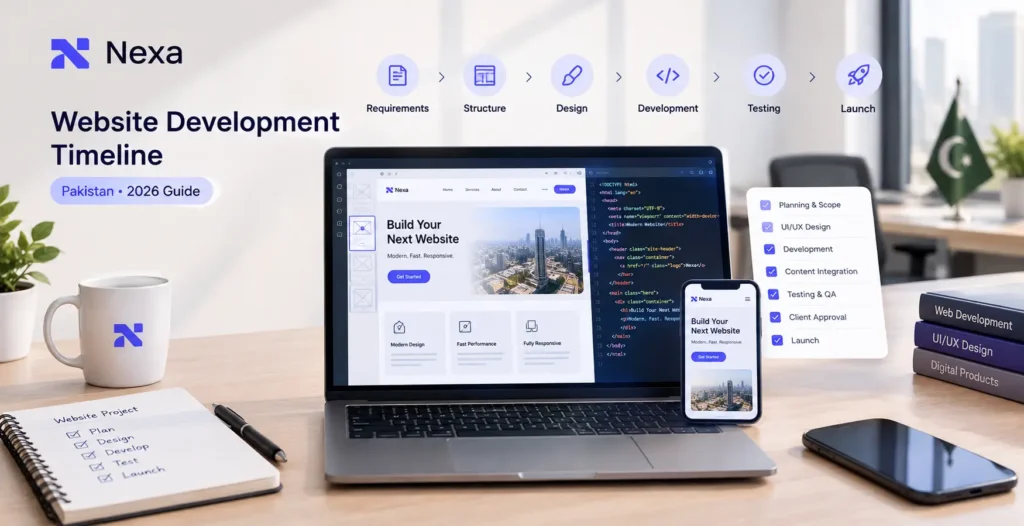
If you are planning a new website for your business, one of the first questions you will probably ask is: how long does it take to build a website in Pakistan?
There is no single timeline that applies to every project. A simple business website and a website with eCommerce, custom functionality, integrations, or complex user journeys require very different amounts of work.
As a current planning benchmark, Nexa Digital Marketing states that most website projects take approximately 2–6 weeks, depending on project complexity. The timeline can also change based on content readiness, feedback, approvals, functionality, design requirements, and other materials needed for the project.
That means the better question is not simply, “How many days will my website take?”
It is:
What needs to be built, how prepared are the project materials, and how quickly can the work move from one stage to the next?
This guide explains the website development timeline in Pakistan, the main stages involved, common causes of delays, and practical steps you can take to get your website launched without rushing important work.
How Long Does It Take to Build a Website in Pakistan?
For most standard website projects, a realistic planning window is a few weeks, not a few days or several months.
Nexa currently publishes an approximate 2–6 week timeline for most website projects. This is not a guarantee for every website. A project with a limited number of pages and standard functionality is easier to manage. In contrast, a project involving custom UI/UX, eCommerce, advanced integrations, extensive content, or specialised functionality may require more planning and development work.
The final website development timeline in Pakistan is usually affected by five broad areas:
- Project scope
- Design and development requirements
- Content readiness
- Client approval and feedback
- Testing, integrations, and launch requirements
The important point is that development time is not the same thing as coding time. A website can take longer because content is missing, a design needs several revisions, a payment system requires testing, or a key decision has not been approved.
What Does the Website Development Process in Pakistan Look Like?
A professional website project usually moves through several connected stages. The exact workflow differs by company and project, but the basic sequence is similar.
1. Website Requirements and Project Brief
The first step is deciding what the website actually needs to accomplish.
This includes questions such as:
- What is the main purpose of the website?
- Who is the target customer?
- How many pages are required?
- What products or services will be shown?
- Will customers submit enquiries, book appointments, or buy products?
- Is a content management system needed?
- Are third-party integrations required?
- What are the must-have features for launch?
This is where a clear website brief can save time.
A good brief reduces uncertainty before design and development begin. It gives the development team a clearer understanding of the project scope rather than forcing important decisions halfway through the build.
2. Website Sitemap and Structure
Next comes the website structure.
A sitemap helps determine which pages the website needs and how those pages relate to each other.
For a service business, the structure might include:
Home → About → Services → Individual Service Pages → Blog → Contact
An eCommerce website could require:
Home → Categories → Products → Cart → Checkout → Account → Support
The purpose is not to create the largest sitemap possible. It is to create a structure that makes sense for users and the business.
Defining the structure early can also reduce unnecessary changes later.
3. UI/UX Design Process
Once the requirements and structure are clear, design work can begin.
The UI/UX design process may cover:
- Page layouts
- Navigation
- Content hierarchy
- Mobile layouts
- Buttons and calls to action
- Forms
- Visual style
- Brand elements
- User journeys
Design is more than choosing colours and images. It determines how visitors move through the website and where important information appears.
4. Website Development
After the design direction is approved, developers build the website.
Depending on the project, development may involve WordPress, a custom website architecture, eCommerce functionality, or other technologies.
This stage may include:
- Front-end development
- Back-end functionality
- CMS setup
- Forms
- Database work
- User accounts
- Content integration
- Responsive behaviour
- Custom features
- Third-party integrations
The level of customisation is one of the main reasons website projects can have very different timelines.
5. Content Integration
Content preparation is often underestimated.
Website content can include:
- Service descriptions
- Product information
- About-page copy
- Images
- Logos
- FAQs
- Contact details
- Policies
- Blog content
If content is ready before development reaches the relevant stage, the project can move more smoothly.
If important content keeps arriving late, the team may have to revisit completed sections, change layouts, or delay testing.
This is why website content preparation should be treated as part of project planning rather than something to solve at the last minute.
6. Testing and Quality Assurance
A website is not finished simply because the pages look complete.
Before launch, it should be reviewed for issues such as:
- Mobile responsiveness
- Navigation
- Forms
- Buttons and links
- Checkout flows where applicable
- Browser compatibility
- Images
- Content errors
- Basic functionality
- Performance
- Technical issues
This stage is commonly referred to as website testing and quality assurance.
It is also one reason why a rushed website launch can create problems. Skipping proper testing may save time on paper while creating more work after launch.
7. Final Approval and Launch
The final stage involves approval, deployment, and launch.
A practical website launch checklist may include:
- Final content review
- Final design approval
- Form testing
- Domain configuration
- Hosting checks
- SSL configuration
- Mobile checks
- Redirect checks where relevant
- Analytics and Search Console setup where required
- Final performance review
Once these checks are complete, the website can be launched.
How Long Does a Basic Website Take to Build?
A basic website is usually less complex than an eCommerce store or a custom web application.
A simple business website may contain standard pages such as:
- Home
- About
- Services
- FAQ
- Contact
Projects of this type generally involve fewer technical dependencies.
However, “basic” does not automatically mean “fast”.
A website can still take longer when:
- The content is not ready
- The page structure changes repeatedly
- The design requires several revisions
- New features are added during development
- Multiple people need to approve decisions
- Branding materials are incomplete
For Nexa’s published benchmark, simpler projects would generally be expected to sit toward the more straightforward end of its 2–6 week range, while more involved projects can require more time. That is a planning interpretation, not a guaranteed turnaround for a specific project.
How Long Does a WordPress Website Take to Build?
There is no single WordPress timeline.
A WordPress website can be relatively straightforward when the requirements are standard, but custom design, extensive content, advanced functionality, integrations, or a large plugin configuration can increase the amount of work.
Nexa’s current WordPress-versus-custom guidance explains that WordPress can be a practical fit for content-managed websites and standard business functionality, while custom development becomes more relevant for specialised workflows, complex dashboards, advanced integrations, and application-like functionality.
So instead of asking whether WordPress is always faster, ask:
How much customisation does this WordPress website actually require?
A highly customised WordPress project can involve considerably more design, development, testing, and maintenance work than a straightforward implementation.
How Long Does an Ecommerce Website Take to Build in Pakistan?
An eCommerce website normally has more moving parts than a standard company website.
The project may need:
- Product categories
- Product pages
- Product variations
- Search and filters
- Shopping cart
- Checkout
- Payment methods
- Shipping rules
- Order management
- Customer accounts
- Inventory features
- Promotional tools
- Analytics
- Product content
A payment gateway integration in Pakistan may also require additional setup and testing, depending on the chosen payment method and the business’s technical requirements.
The same is true for courier systems, inventory tools, CRMs, accounting software, or other third-party services.
This is why an online store should not be given a timeline simply by counting the number of pages.
A store with a small product catalogue and straightforward checkout has a very different scope from a large catalogue connected to multiple business systems.
How Long Does a Custom Website Take to Build?
Custom development is generally more complex when the website needs functionality designed specifically around a business workflow.
Examples include:
- Customer portals
- Booking systems
- Custom dashboards
- Membership areas
- Business automation
- Advanced directories
- Custom calculators
- Specialised databases
- API integrations
- Complex user roles
- Custom web applications
The more specialised the requirements, the more time may be needed for requirements analysis, UI/UX design, development, testing, and refinement.
A custom project should therefore start with a detailed website project scope.
Without a clear scope, it becomes difficult to produce a reliable timeline.
What Affects Website Development Time?
Several factors can change the expected timeline.
Number of Pages
A five-page website and a large website with dozens of pages require different amounts of content preparation, design, development, and testing.
Design Complexity
A standard design system can be easier to implement than a highly customised visual experience with advanced interactions and animations.
Functionality
Forms, bookings, search systems, user accounts, calculators, dashboards, product configurators, and other features can add development and testing requirements.
Integrations
Third-party integrations can introduce dependencies outside the website itself.
These might include:
- Payment systems
- CRMs
- Accounting platforms
- Inventory systems
- Courier services
- Email platforms
- APIs
- Booking systems
The more systems that need to communicate with the website, the more integration and testing work may be required.
Content Readiness
Missing text, images, product information, or brand assets can slow down progress.
Client Approval and Feedback
Fast development can still be delayed by slow feedback.
When several people need to review every change, the approval process can become a significant part of the overall schedule.
Revision Rounds
A project usually needs some level of refinement.
But repeated changes after approval can result in rework. The more a design or feature changes after development has started, the more likely the timeline is to slip.
What Causes Website Development Delays?
Some delays are technical. Many are related to project management.
1. The content is not ready
Developers cannot always complete a page when key copy or images are missing.
2. The scope keeps changing
This is commonly called scope creep in web development.
For example, a business may begin with a standard service website and later add:
- Online bookings
- Customer login
- Advanced search
- Product sales
- CRM integration
- Custom dashboards
Each new requirement can affect design, development, testing, and launch.
3. Feedback arrives late
A development project needs decisions.
If important approvals take several days, the project schedule may move even when the technical work is proceeding normally.
4. Too many decision-makers are involved
Different stakeholders may have different opinions about the design, content, or functionality.
Assigning a clear decision-maker can help prevent unnecessary back-and-forth.
5. Third-party integrations are more complex than expected
An integration may require additional credentials, documentation, configuration, testing, or changes to the website architecture.
6. New requirements appear near launch
Late additions can affect features that have already been tested.
For this reason, a controlled final scope is important before the launch stage.
How Can You Speed Up Website Development?
Speed should come from better planning, not from skipping important work.
Prepare your content early
Have your text, images, logo, service information, product details, and other required materials ready.
Create a clear website brief
Write down the goals, pages, features, integrations, and target audience before development begins.
Finalise the sitemap early
A stable structure reduces unnecessary design and development changes.
Choose one main decision-maker
A clear approval process is often faster than sending every design decision through several people.
Separate must-have features from future ideas
Not every feature needs to be included at launch.
A useful approach is to identify:
Must have: required for launch
Should have: useful but not critical
Later: can be added after launch
This protects the initial project scope.
Provide feedback in batches
Instead of sending separate changes throughout the week, organise feedback into one clear review.
Start integrations early
If the website needs payment, CRM, courier, booking, or API integrations, identify those requirements before development is well underway.
Avoid unnecessary redesigns during development
Changing the approved direction repeatedly increases rework.
How Long Does It Take to Design a Website?
Website design and website development are related, but they are not exactly the same task.
Design focuses on how the website should look and work from the user’s perspective.
Development turns that approved direction into a functioning website.
The time required for design depends on:
- Number of templates or pages
- UI/UX complexity
- Brand requirements
- Mobile layouts
- Custom components
- Revision rounds
- Approval speed
A simple website may require a relatively straightforward design system. A more complex project may require more detailed user flows, custom screens, and multiple interface states.
The important thing is to allow enough time for the design to be reviewed before extensive development begins.
How Long Does a Website Redesign Take in Pakistan?
A redesign can mean very different things.
A visual refresh may involve updating:
- Colours
- Typography
- Layouts
- Images
- Calls to action
- Mobile presentation
A larger redesign may also involve changes to:
- Website structure
- Navigation
- Content
- URLs
- CMS
- Functionality
- Integrations
- Technical architecture
An existing website that needs a visual improvement may therefore take less work than a complete rebuild.
Before choosing between redesign and rebuilding, assess what is already working and what actually needs to change.
Does a Longer Website Timeline Mean Better Quality?
Not necessarily.
A longer project is not automatically better, and a very short project is not automatically worse.
The right timeline depends on the scope.
A project can be delayed because of poor planning, slow communication, unclear requirements, or repeated changes. Another project may take longer because it genuinely requires complex functionality and extensive testing.
The goal should be a realistic website development timeline, not the shortest possible deadline.
A useful developer or agency should be able to explain:
- What will be delivered
- Which stages are involved
- What the client needs to provide
- What could affect the schedule
- How approvals work
- What happens before launch
- What is included after launch
Does Website Development Cost Affect the Timeline?
Often, yes, but cost and time should not be treated as interchangeable.
More expensive projects may include more design work, custom functionality, integrations, content, testing, or technical requirements.
However, a higher price does not automatically mean a longer timeline.
The real relationship is usually between scope, complexity, resources, and time.
Nexa’s separate guide on Website development cost in Pakistan covers the pricing side in more detail.
Should SEO Be Included During Website Development?
SEO should not be treated only as a task to complete after the website is live.
Important foundations can be considered during development, including:
- Website structure
- Descriptive URLs
- Internal linking
- Mobile usability
- Page performance
- Crawlability
- Indexation
- Content structure
Google’s current guidance continues to emphasise foundational SEO practices and people-first content. Google also states that there are no special technical requirements for appearing in AI Overviews or AI Mode beyond the normal requirements for appearing in Google Search.
That makes SEO-friendly development a planning issue as much as a post-launch optimisation issue.
For businesses concerned about performance, Nexa also provides a dedicated Website speed optimisation resource.
What Should You Ask Before Starting a Website Project?
Before agreeing to a website development timeline, ask the developer or agency:
What exactly is included?
Confirm the number of pages, design work, functionality, content, integrations, testing, and launch support.
What do you need from me?
Ask for a complete list of content, brand materials, access details, approvals, and other required inputs.
How are revisions handled?
Understand how design revisions and changes to scope may affect the schedule.
Who owns the website?
Clarify ownership and access to your domain, hosting, CMS, website files, and important accounts.
What happens after launch?
Ask whether maintenance, updates, support, or future development are available and whether they are included or separate.
A Practical Way to Think About Your Website Timeline
Instead of thinking about the project as:
“I need a website, so how many days will it take?”
Think about it as:
Requirements → Structure → Design → Development → Content → Testing → Approval → Launch
Every stage needs to move forward.
If requirements are unclear, the project starts slowly.
If content is missing, pages can stall.
If design approvals are delayed, development may be delayed.
If the scope changes, previously completed work may need to be revisited.
If integrations are complicated, testing can take longer.
If final checks reveal problems, the launch may need to move.
This is why a good website timeline is based on the actual project rather than a universal number.
What to Expect When Building a Website in Pakistan
So, how long does it take to build a website in Pakistan?
As a current Nexa planning benchmark, most website projects take approximately 2–6 weeks, but that range should not be treated as a guarantee for every business. The actual website development time depends on scope, design, functionality, content readiness, integrations, revisions, testing, feedback, and approvals.
A basic business website may sit toward the simpler end of the process, while eCommerce stores, heavily customised websites, and application-style projects can require more planning and development work.
The best way to keep your project on schedule is to prepare your requirements early, define the website scope, organise your content, make decisions promptly, and avoid adding major features after development is already underway.
For businesses that are planning a new website, Nexa’s Web Design & Development services provide a starting point for discussing the project’s requirements, scope, design, development, testing, and launch.
Contact Nexa Digital Marketing to discuss what your website needs before committing to a development timeline.
Frequently Asked Questions
1. How long does a website take to build in Pakistan?
Nexa’s current published benchmark says most website projects take approximately 2–6 weeks. The exact timeline depends on complexity, content, functionality, feedback, approvals, and required materials.
2. Can a website be built in one week?
A highly limited project may be possible in a short timeframe, but a one-week deadline should not be assumed for every website. The more pages, custom design, functionality, integrations, revisions, and testing a project requires, the more time it may need.
3. How long does an eCommerce website take to build in Pakistan?
There is no universal eCommerce timeline. Product structure, catalogue size, checkout requirements, payment gateway integration, shipping, inventory, customer accounts, and third-party systems can all affect the schedule.
4. How long does it take to build a WordPress website?
The timeline depends on how much customisation is required. A straightforward WordPress project can be simpler to build than a highly customised WordPress website with extensive content, custom functionality, integrations, and testing. Nexa’s WordPress-versus-custom guide explains the main differences between the two approaches.
5. What causes website development delays?
Common causes include missing content, unclear requirements, scope changes, slow client approvals, repeated revisions, multiple decision-makers, and third-party integration problems.
6. Can I speed up website development?
Yes. Prepare your content and website requirements early, finalise the sitemap, give consolidated feedback, assign a clear decision-maker, identify integrations before development, and separate launch-critical features from future additions.
7. Does website redesign take less time than building a new website?
It can, but not always. A visual refresh may require less work than a complete rebuild. If the redesign also changes the website structure, CMS, functionality, integrations, URLs, or technical architecture, the project can become much more involved.
8. Should I choose a freelancer or a web development company?
That depends on the project’s scope, technical complexity, communication needs, and ongoing requirements. The more important issue is whether the person or team can clearly define the scope, explain the development process, manage revisions, complete testing, and provide appropriate access and ownership.