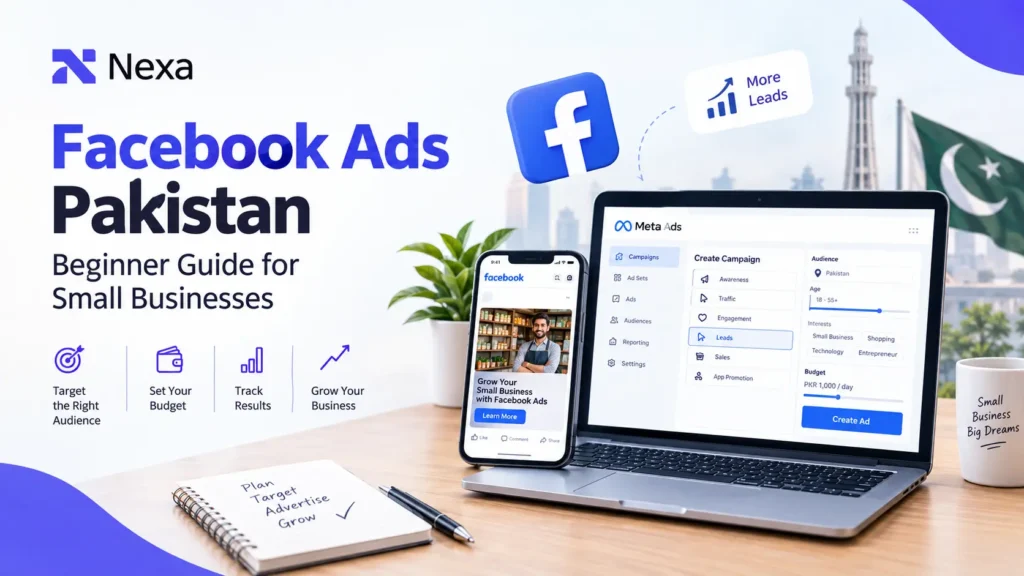
Facebook Ads in Pakistan can help small businesses reach potential customers, generate enquiries, promote products, and build demand without relying only on organic social media reach. But launching an ad and building a campaign are not the same thing.
For a small business, the real challenge is deciding what to advertise, who to target, which campaign objective to use, how much to spend, what to measure, and when to make changes.
This guide explains how Facebook and Meta Ads work for small businesses in Pakistan, how to plan a first campaign, how targeting and creative fit together, what costs actually mean, and which mistakes can waste your budget.
What Are Facebook Ads?
Facebook Ads are paid advertisements delivered through Meta’s advertising ecosystem. Businesses can use them to promote products, services, offers, content, lead forms, websites, or messaging conversations.
In practice, a business may manage Facebook and Instagram campaigns together rather than treating them as completely separate advertising channels. Meta’s advertising tools also support different placements, including Feed, Stories and Reels.
For a small business, Facebook Ads can be used for several outcomes:
- Building awareness for a new business or offer
- Sending visitors to a website or landing page
- Generating leads through forms
- Starting conversations through messaging
- Promoting products for ecommerce
- Retargeting people who have already interacted with the business
- Supporting launches, promotions, events, or seasonal campaigns
The important point is that the goal should come before the ad.
A campaign designed to generate leads should not be judged mainly by likes. An ecommerce campaign should not be judged only by impressions. Your objective and measurement system should match the business outcome you actually want.
Why Facebook Ads Can Make Sense for Small Businesses in Pakistan
Small businesses usually cannot afford to waste large amounts of money testing every possible marketing channel.
That makes focused paid advertising more useful than simply increasing activity.
For example:
| Business type | Possible Facebook Ads goal |
| Local salon | WhatsApp enquiries or appointment leads |
| Restaurant | Local awareness, offers or orders |
| Real estate business | Lead generation and enquiries |
| Clothing brand | Product discovery and sales |
| Ecommerce store | Product sales and retargeting |
| Training institute | Course enquiries and registrations |
| Home services company | Local service leads |
| Professional service | Consultation or quote requests |
The key is to connect the campaign to the customer journey.
A person seeing your business for the first time may need awareness and trust. Someone who visited your website may need a reminder. Someone who already knows your business may be ready to inquire.
That is why Facebook Ads targeting in Pakistan should not be treated as simply selecting an age range and a city.
Before You Run Facebook Ads, Fix the Basics
One of the biggest mistakes small businesses make is sending paid traffic into an incomplete marketing system.
Before launching your first campaign, check these basics:
1. Have a clear offer
People need a reason to take action.
Your offer could be:
- A product
- A consultation
- A service
- A booking
- A free assessment
- A limited-time promotion
- A quote request
- A product bundle
An ad cannot compensate for an unclear offer.
2. Make your business easy to trust
Your Facebook or Instagram presence should clearly communicate:
- What your business does
- Who it serves
- Where it operates
- How customers can contact you
- What products or services are available
- Why someone should consider you
For website campaigns, your landing page should also be clear and easy to use.
Nexa’s broader guide to Digital marketing for small businesses in Pakistan discusses the importance of clear websites, trust signals, contact options, WhatsApp, social media and lead tracking as part of the wider customer journey.
3. Decide what counts as a conversion
Before spending money, define the action you actually care about.
For example:
Lead generation: completed lead form, qualified enquiry, phone call or WhatsApp conversation.
Ecommerce: completed purchase and revenue.
Local service: appointment, quotation request or qualified message.
Awareness: reach, video consumption or engagement may matter more than direct sales.
This makes your campaign easier to evaluate later.
How to Run Facebook Ads in Pakistan: Step-by-Step
Step 1: Set Up Your Meta Advertising Assets
You need the appropriate business and advertising assets before you start spending.
Depending on your setup, this can include:
- Facebook Page
- Instagram account
- Meta business assets
- Advertising account
- Payment method
- Website or landing page
- Tracking setup
- Product catalogue for applicable ecommerce campaigns
Use appropriate account access rather than giving unnecessary full control to everyone involved.
This becomes particularly important when working with an external Facebook Ads agency in Pakistan. Your business should retain appropriate ownership and access to its core advertising assets and data.
Step 2: Choose the Right Facebook Ad Campaign Objective
Your campaign objective should reflect the action you want Meta’s system to optimise towards.
Common business goals include:
| Goal | Suitable approach |
| Build awareness | Awareness-focused campaign |
| Drive website visits | Traffic-focused campaign |
| Generate enquiries | Lead generation |
| Start conversations | Messaging/WhatsApp campaign |
| Sell products | Sales/conversion campaign |
| Re-engage previous visitors | Retargeting |
The mistake is choosing an objective simply because the name sounds attractive.
For example, if your actual goal is qualified leads, generating large amounts of cheap traffic may not solve the business problem.
Think:
Business goal → Campaign objective → Audience → Creative → Conversion action → Measurement
That chain is more useful than simply asking, “How do I run Facebook Ads?”
Step 3: Define Your Facebook Ads Targeting in Pakistan
Targeting should begin with your actual customer, not with a random collection of interests.
Think about:
- Location
- Age group
- Gender where genuinely relevant
- Language where relevant
- Customer needs
- Interests
- Existing customer data
- Website visitors
- Social media engagers
- Product or service category
- Buying stage
Local targeting
A local business does not necessarily need to advertise across the entire country.
A Lahore-based service business may need to concentrate around Lahore. A business operating in multiple cities may need separate geographic testing.
The important question is:
Where can the business actually serve the customer?
Custom Audiences
Custom Audiences can be useful when you already have relevant first-party customer or engagement data.
Potential sources include:
- Existing customers
- Website visitors
- People who interacted with your content
- Previous leads
- Other eligible business data
Meta’s terms for customer-list audiences require advertisers to have the necessary rights and permissions to use the data.
Lookalike Audiences
Lookalike Audiences can help you reach new people who share characteristics with an existing audience.
They become more useful when your business already has meaningful customer or conversion data rather than relying only on assumptions about who might buy.
Step 4: Decide Where Customers Should Go
Not every Facebook ad needs to send people to a website.
Depending on your business, the next step may be:
- Website
- Landing page
- Facebook lead form
- Product page
- Booking page
- Phone call
Click-to-WhatsApp Ads
For a business that handles enquiries through WhatsApp, sending an interested person directly into a conversation can reduce unnecessary steps.
For example:
Ad → WhatsApp → Business response → Qualification → Quote/booking
This can be useful for businesses such as:
- Salons
- Clinics
- Real estate
- Home services
- Restaurants
- Education and training
- Professional services
- Local retailers
But the ad itself is only one part of the system. A slow response, unclear pricing, poor communication, or weak follow-up can still lose the lead.
Nexa’s existing small-business marketing guidance also emphasises the importance of clear contact options and fast follow-up after an enquiry.
Step 5: Create Facebook Ad Creative That Matches the Offer
A campaign can have a good audience and still underperform because the creative does not give people a reason to stop scrolling.
Your Facebook ad creative can include:
- Static images
- Short videos
- Reels
- Product demonstrations
- Customer-focused visuals
- Before-and-after presentations where appropriate
- Educational content
- Offers
- Testimonials where genuine and verifiable
A useful ad usually answers several questions quickly:
What is this?
Who is it for?
Why should I care?
What should I do next?
For example, instead of a generic:
“We provide digital marketing services.”
A more specific message might focus on the customer’s problem:
“Getting website visitors but not enough enquiries? Here are three conversion issues to check first.”
The second message gives the viewer a clearer reason to pay attention.
For Reels, Meta recommends mobile-oriented creative and provides placement guidance around vertical video, creative positioning and testing.
Step 6: Choose Your Facebook Ad Placements
Your ads may appear across different Meta placements depending on your campaign setup.
These can include formats such as:
- Facebook Feed
- Instagram Feed
- Stories
- Reels
- Messenger
- Other eligible Meta placements
Meta provides both automated and manual placement approaches for applicable campaigns, with Reels included within broader placement options.
For a beginner, avoid assuming that one placement is automatically best.
Instead, consider:
- Where your audience spends time
- What creative format you have
- Whether the placement suits the message
- Whether the resulting leads or sales are useful
- Whether tracking can tell you what is actually happening
A cheap result is not necessarily a good result.
Step 7: Set a Facebook Ads Budget in Pakistan
There is no single Facebook Ads budget that works for every Pakistani business.
Your required budget depends on factors such as:
- Campaign objective
- Audience size
- Competition
- Offer
- Creative quality
- Conversion rate
- Customer value
- Sales process
- Geographic targeting
- Testing requirements
This is why you should be careful with articles promising one universal “best Facebook Ads budget”.
Nexa’s own PPC guidance states that campaign budgets depend on industry, competition and goals, while advertising spend is separate from its management fee.
Think in terms of testing, not just spending
A practical approach is:
Budget → Test → Measure → Learn → Improve → Scale
Do not increase your budget simply because an advertisement receives many clicks.
First ask:
- Are people taking the intended action?
- Are leads relevant?
- Are enquiries becoming opportunities?
- Are products actually selling?
- Is the cost acceptable compared with the customer’s value?
Facebook Ads Cost in Pakistan: What Should a Small Business Actually Pay?
One of the most common questions is:
How much do Facebook Ads cost in Pakistan?
The answer has several parts.
1. Ad spend
This is the money used to run advertisements on Meta.
2. Creative costs
You may also have costs associated with:
- Graphic design
- Video production
- Photography
- Copywriting
- Editing
3. Management costs
An agency or freelancer may charge separately for campaign strategy, setup, management, optimisation and reporting.
These are different costs and should not be mixed together.
There is also no fixed CPC, CPM or CPL that every Pakistani business should expect. Different objectives, audiences, industries and campaigns can produce very different results. Current Pakistan-focused cost guides also show substantial variation in the benchmarks they publish, which is one reason a universal price should be treated cautiously.
For a small business, the better question is not:
“What is the cheapest Facebook ad?”
It is:
“What does it cost us to acquire a useful customer or qualified lead?”
Meta Pixel and Conversions API: Why Tracking Matters
If you send people from Facebook Ads to your website, you need a way to understand what happens after the click.
Tracking can help connect advertising activity with actions such as:
- Page views
- Lead submissions
- Purchases
- Registrations
- Other conversion events
For website campaigns, businesses may use the Meta Pixel alongside broader server-side measurement options such as Conversions API (CAPI).
The exact technical implementation depends on the website, platform, event structure and tracking setup.
The important principle for a small business is simple:
Do not judge paid advertising only by clicks.
If a campaign produces 1,000 visits but no useful enquiries or purchases, the click count alone does not prove success.
Nexa’s PPC service states that conversion tracking and optimisation are part of its paid advertising process.
Facebook Ad Metrics Small Businesses Should Understand
You do not need to monitor every available metric.
Start with the numbers that answer your business questions.
| Metric | What it tells you |
| Reach | How many people saw the ad |
| Impressions | How often the ad was displayed |
| CTR | How often people clicked relative to impressions |
| CPC | Average cost for a click |
| CPL | Average cost for a lead |
| CPA | Cost to acquire the desired action |
| Conversion rate | How often visitors complete the intended action |
| ROAS | Revenue generated relative to advertising spend |
Why ROAS matters for ecommerce
Suppose a store spends money on Facebook Ads and generates sales.
The important question is not just:
“How many people clicked?”
It is:
“How much revenue did the advertising produce, and was that revenue profitable?”
ROAS can help frame that conversation, but it should not be treated as the only number that matters. Margins, fulfilment costs, discounts, returns and other expenses can affect actual profitability.
Boosted Posts vs Ads Manager
A boosted post is not the same thing as a properly planned advertising campaign.
Boosting can be convenient when a business simply wants more exposure for existing content.
Ads Manager is more appropriate when the business needs greater control over:
- Campaign objectives
- Audience strategy
- Conversion-focused campaigns
- Testing
- Retargeting
- Tracking
- Budget management
- Performance analysis
This distinction is one of the recurring themes in current Pakistan-focused beginner guides.
The bigger lesson is:
Do not use a simple boosting button as a substitute for a complete advertising strategy.
Facebook Retargeting for Small Businesses
Not everyone buys the first time they see an advertisement.
Someone may:
- See your ad
- Visit your website
- View a product
- Leave
- Compare competitors
- Return later
Retargeting gives businesses a way to reconnect with eligible audiences who have already interacted with the brand.
Potential retargeting groups can include:
- Website visitors
- Product viewers
- Engaged social-media users
- Previous customers
- People who started but did not complete an action
For ecommerce businesses, this can become particularly useful because the customer journey often includes several visits before a purchase.
Facebook Ads for Different Types of Small Businesses in Pakistan
Facebook Ads for Local Businesses
Local businesses should usually make location an important part of the strategy.
Examples include:
- Salons
- Clinics
- Restaurants
- Gyms
- Repair services
- Education centres
- Real estate businesses
- Home services
A local campaign could focus on:
Area → Offer → Trust → Enquiry
For some businesses, WhatsApp or lead forms may make more sense than sending every person to a large website.
Facebook Ads for Ecommerce Businesses
Ecommerce campaigns need to think beyond traffic.
Important considerations include:
- Product pages
- Creative quality
- Product images
- Pricing
- Offers
- Tracking
- Retargeting
- Customer trust
- Checkout experience
A product advertisement can generate clicks but still struggle to produce sales if the product page, delivery information, payment process or offer creates friction.
For businesses building organic visibility alongside paid acquisition, Nexa’s Ecommerce SEO services can complement paid traffic by strengthening search visibility around products and commercial queries.
Facebook Ads for Service-Based Businesses
Service businesses often need qualified enquiries rather than large traffic numbers.
Useful campaign destinations may include:
- Lead forms
- Contact forms
- Booking pages
- Dedicated landing pages
The ad should make the service understandable before the person takes action.
For example, a construction company might focus on a consultation or quotation, while a training institute might focus on course registration.
Facebook Ads vs Google Ads for Small Businesses
Facebook Ads and Google Ads can support different stages of the buying journey.
Facebook/Meta Ads
Often useful when you want to:
- Create demand
- Introduce a product
- Reach specific audiences
- Retarget previous visitors
- Promote visual content
- Generate social or messaging-based enquiries
Google Ads
Often useful when people are already searching for:
- A product
- A service
- A local provider
- A specific solution
A person searching:
“SEO company in Lahore”
has a different kind of intent from someone seeing a Facebook video introducing an SEO service.
Neither channel is automatically the right choice for every business.
The decision should depend on:
Customer behaviour + business objective + offer + buying journey + tracking + budget
Nexa also has a separate guide covering Google Ads for small businesses in Pakistan, which can help when comparing paid search with social advertising.
Common Facebook Ads Mistakes Small Businesses Should Avoid
1. Boosting every post
Not every piece of organic content deserves a paid budget.
2. Choosing the wrong objective
A traffic campaign does not automatically create qualified leads.
3. Targeting without a customer definition
Selecting interests randomly is not the same as understanding your market.
4. Using weak creative
A campaign cannot compensate for an uninteresting or unclear advertisement.
5. Sending traffic to a poor landing page
A good ad followed by a confusing page creates wasted spend.
If your website receives visitors but does not generate enquiries, review your page experience as well. Nexa’s guide on Why your website may not be getting leads covers issues such as messaging, calls to action, landing pages and conversion problems.
6. Ignoring tracking
Without conversion tracking, it becomes difficult to distinguish useful advertising from activity that simply looks busy.
7. Changing everything too quickly
A campaign needs enough useful data to evaluate what is happening. Constantly changing audience, creative, objective and budget at the same time can make learning harder.
8. Focusing only on cheap clicks
Cheap traffic is not necessarily valuable traffic.
A higher-cost lead that consistently becomes a customer may be more useful than a large number of cheap but irrelevant enquiries.
How to Improve Facebook Ads Performance
Once your campaign has enough useful data, optimisation should become an ongoing process.
Look for patterns in:
- Audience quality
- Creative performance
- Placement performance
- Lead quality
- Landing-page behaviour
- Conversion rate
- Cost per lead
- Cost per acquisition
- Sales value
- ROAS
Then test one meaningful change at a time where it is practical.
For example:
Test 1: Different ad hooks
Test 2: Different creative formats
Test 3: Different audience segments
Test 4: Different landing-page message
Test 5: Different offer or call to action
This gives you a better understanding of what is actually affecting performance.
Nexa’s own PPC process includes research, audience targeting, campaign setup, ad creation, ongoing optimisation, competitor analysis, conversion tracking and A/B testing.
When Should a Small Business Hire a Facebook Ads Agency in Pakistan?
Managing ads yourself can make sense when:
- You have enough time to learn the platform
- Your campaign is relatively simple
- You can create and test suitable creative
- You understand your audience
- You can track conversions properly
- You are comfortable reviewing performance data
Professional Facebook Ads management in Pakistan may become more useful when:
- Campaigns are spending but not producing useful results
- You need more advanced tracking
- You have several audiences or campaigns
- You need continuous creative testing
- You run ecommerce campaigns
- You want structured retargeting
- You do not have time to manage campaigns consistently
- You need paid advertising connected with landing pages, social media and conversion optimisation
The important thing is not simply to hire an agency because advertising feels complicated.
First identify the actual problem:
Strategy? Targeting? Creative? Tracking? Landing page? Follow-up?
A good advertising process should address the underlying issue rather than simply increase spend.
A Simple Facebook Ads Framework for Pakistani Small Businesses
For a beginner, the process can be simplified to:
1. Define the business goal
Lead, sale, enquiry, booking, message or awareness.
2. Identify the customer
Location, needs, buying situation and customer journey.
3. Create the offer
Give people a clear reason to act.
4. Choose the campaign objective
Match the objective to the desired outcome.
5. Build the audience
Use relevant geographic, demographic and audience signals.
6. Create the ads
Develop useful, clear and platform-appropriate creative.
7. Choose the conversion destination
Website, lead form, WhatsApp, booking page or another suitable destination.
8. Track the important actions
Measure what matters to the business.
9. Review performance
Look beyond likes and clicks.
10. Improve and scale carefully
Keep what works, change what does not, and avoid increasing spend before the underlying campaign is ready.
Should Small Businesses in Pakistan Use Facebook Ads?
Facebook Ads can be a useful channel for a small business when there is:
- A clear offer
- A defined customer
- Appropriate targeting
- Suitable creative
- A strong conversion path
- Proper measurement
- A realistic budget
But Facebook Ads are not a shortcut around weak marketing fundamentals.
If the offer is unclear, the website is difficult to use, the lead response is slow, or tracking is incomplete, increasing ad spend may simply increase waste.
For businesses considering paid acquisition alongside SEO, websites and social media, the stronger approach is to treat advertising as part of the wider customer journey rather than as an isolated activity.
Nexa’s Paid Advertising (PPC) service covers paid campaign strategy, audience targeting and retargeting, conversion tracking, optimisation, ad creative and campaign management across platforms including Facebook and Instagram.
A Practical Facebook Ads Strategy for Small Businesses
The goal of Facebook Ads for small businesses in Pakistan should not be to get the highest number of clicks or the largest amount of reach.
The goal is to create a clear path:
Right audience → relevant message → useful offer → appropriate destination → measurable action → optimisation
Start with the customer and business objective. Then build the campaign around them.
A small, well-measured campaign can teach you far more than a large campaign launched without a clear strategy. As you collect useful data, you can refine targeting, creative, landing pages, retargeting and budget decisions.
For a business that needs help managing this process, Nexa Digital Marketing’s Paid Advertising (PPC) services provide a natural next step for campaign strategy, targeting, tracking and optimisation.
Frequently Asked Questions
1. How much do Facebook Ads cost in Pakistan?
There is no single fixed Facebook Ads price in Pakistan. Your total cost can include advertising spend, creative production and campaign management. Actual advertising costs vary according to the objective, audience, competition, creative, location and conversion process.
2. What is the best Facebook Ads objective for a small business?
It depends on the business goal. Lead-generation campaigns may suit service businesses, messaging campaigns can support businesses that handle enquiries through WhatsApp, and sales-focused campaigns may be more appropriate for ecommerce. The objective should match the action you want customers to take.
3. Can I run Facebook Ads with a small budget?
Yes, but the useful question is whether your budget is sufficient to generate enough meaningful data for your chosen objective. There is no universal “best” budget for every business. Start with a controlled test and judge performance based on useful business outcomes.
4. Is Facebook Ads better than Google Ads for a small business in Pakistan?
Neither is automatically better for every business. Facebook Ads can help create demand, reach specific audiences and support retargeting, while Google Ads can be particularly useful when customers are already searching for a product or service. The right option depends on the buying journey and business objective.
5. Should I boost Facebook posts or use Ads Manager?
Boosting can be suitable for simple promotion, but Ads Manager provides greater control over campaign objectives, audiences, conversion-focused campaigns, testing, tracking and optimisation. Businesses running serious lead-generation or sales campaigns should understand the difference.
6. Do I need a website to run Facebook Ads?
Not always. Depending on the campaign, a business can use lead forms or messaging destinations such as WhatsApp. However, a well-designed website or landing page can be important when customers need more information, trust signals, product details or a structured conversion experience.