
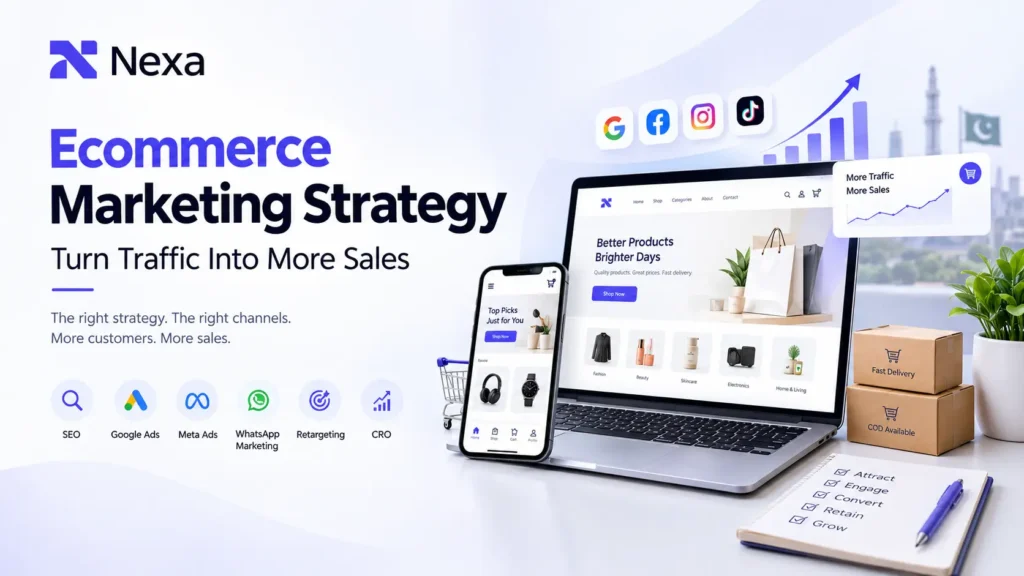
Running an online store is not the same as simply putting products on a website and waiting for orders.
A Pakistani ecommerce business needs a system that brings the right people to the store, helps them trust the brand, makes purchasing easy, and gives them a reason to buy again. That is what a strong ecommerce marketing strategy is designed to do.
For some businesses, that may mean investing more heavily in Meta Ads and Google Ads. For others, SEO, content, social media, WhatsApp, conversion optimisation, or customer retention may have a bigger role. The right mix depends on the product, audience, margins, buying cycle, website experience, and business objectives.
This guide explains how to build an ecommerce marketing strategy in Pakistan around the complete customer journey — from attracting visitors to increasing completed and repeat orders.
What Is an Ecommerce Marketing Strategy?
An ecommerce marketing strategy is a structured plan for attracting potential customers to an online store, converting visitors into buyers, and encouraging existing customers to purchase again.
It can include:
- Search engine optimisation
- Google Ads and Google Shopping
- Facebook and Instagram advertising
- Social media marketing
- Content marketing
- TikTok marketing
- WhatsApp marketing
- Retargeting
- Conversion rate optimisation
- Email and customer retention
- Analytics and performance measurement
The important point is that these channels should not operate independently.
For example, a customer might discover a product through an Instagram Reel, visit the website, leave without purchasing, return through a Google search or retargeting ad, ask a question on WhatsApp, place a COD order, and later return to purchase another product.
An effective strategy connects those interactions instead of treating each one as a separate campaign.
Why Ecommerce Marketing in Pakistan Requires a Local Approach
A marketing strategy that works for an international ecommerce store should not automatically be copied for Pakistan.
Local ecommerce businesses may need to account for factors such as:
- Cash on Delivery (COD)
- Customer hesitation before ordering
- WhatsApp-based enquiries
- Mobile-first shopping
- Delivery and courier considerations
- Price comparison
- Exchange and return concerns
- Trust in unfamiliar online stores
- Social-media-led product discovery
- Different levels of digital payment adoption
- City and delivery-area considerations
Recent Pakistan-focused ecommerce guides repeatedly highlight the importance of COD, WhatsApp, mobile experiences, social commerce, retargeting, and conversion optimisation.
This does not mean every online store should use every channel. It means your strategy should reflect how your specific customers actually discover, evaluate, and purchase products.
1. Start With Your Ecommerce Customer and Product
Before spending money on advertising, define what you are selling and who is most likely to buy it.
A useful ecommerce marketing plan should answer:
Who is the customer?
Consider age, location, interests, purchasing power, lifestyle, and likely objections.
What problem does the product solve?
A product should be marketed around the customer’s need, not only its technical features.
Why should someone choose your store?
Possible differentiators may include product quality, selection, convenience, customer support, delivery coverage, brand positioning, or another genuine advantage.
How does the customer make the purchase decision?
A low-cost impulse product may require a different funnel from an expensive product that customers research for several days.
What prevents the customer from buying?
Common barriers include price, trust, shipping cost, unclear returns, poor product information, slow websites, or uncertainty about the product itself.
Your answers should influence every part of the campaign — from ad creative to landing pages and checkout.
2. Build a Website That Can Convert Marketing Traffic
An ecommerce marketing campaign cannot compensate indefinitely for a poor website.
You can generate thousands of visitors, but those visitors still need a useful product page and a simple buying process.
Your store should make it easy for visitors to understand:
- What the product is
- Who it is for
- How much it costs
- What they receive
- When it can be delivered
- How they can pay
- What happens if they need an exchange or return
- How they can contact the business
Mobile usability is particularly important because many customers discover products through mobile social platforms and search.
Look carefully at your:
- Mobile navigation
- Product images
- Product descriptions
- Price visibility
- Add-to-cart button
- Checkout forms
- Shipping information
- Payment options
- Trust signals
- Contact options
- Page speed
Nexa’s Web Design & Development service focuses on responsive, performance-oriented and conversion-focused websites, which makes it a relevant supporting service for ecommerce businesses working on the website side of their funnel.
For more detail, see our guide on Website speed optimisation.
3. Use Ecommerce SEO for Long-Term Organic Visibility
Paid advertising can bring traffic quickly, but ecommerce SEO can help a store build visibility around searches related to products, categories, problems, comparisons, and buying decisions.
A strong ecommerce SEO strategy can include:
- Product-page optimisation
- Category-page optimisation
- Search-intent research
- Internal linking
- Technical SEO
- Structured product information
- Content development
- Image optimisation
- Search-friendly site architecture
The objective is not simply to rank product pages for random keywords. The site should help search engines understand which products, categories, and content are important.
Nexa’s existing Ecommerce SEO Services in Pakistan guide covers technical SEO, product and category optimisation, keyword research, content, internal linking, and measurement.
A useful ecommerce strategy therefore treats SEO as one part of the larger sales system rather than the entire strategy.
4. Use Google to Capture Existing Purchase Intent
Google can be valuable when customers are already searching for a product or category.
Depending on the business and eligibility, ecommerce brands may use:
- Google Search Ads
- Google Shopping
- Product listings
- Merchant Center
- Remarketing
- Organic search
Google Merchant Center allows businesses to provide product information that can be used to show products across Google surfaces. Google also recommends keeping product and store information accurate, descriptive and up to date.
This makes product data an important part of ecommerce marketing.
Your product feed should accurately represent:
- Product name
- Price
- Availability
- Images
- Relevant attributes
- Product landing page
- Store information
Google’s Merchant Center policies also emphasise that product listings should lead to relevant, useful and easy-to-use landing pages and that merchants should not misrepresent products or offers.
For a deeper explanation of paid search, see Google Ads for Small Businesses in Pakistan.
5. Use Facebook and Instagram Ads to Create Demand
Not every potential customer starts with a Google search.
Many shoppers first discover products while scrolling through Facebook, Instagram, TikTok, or other social platforms.
This is where paid social can help create product awareness and generate traffic from audiences that may not have been actively searching for the product.
For ecommerce, campaign planning can involve:
- Product-focused creatives
- Video demonstrations
- Reels
- Carousel formats
- Catalog-based advertising
- Retargeting
- Customer testimonials or user-generated content
- Different creative angles for different audience segments
The creative should answer a simple question:
Why should this person stop scrolling and consider this product?
That might be a problem, benefit, use case, product demonstration, comparison, offer, or customer concern.
Nexa’s Facebook Ads for Small Businesses in Pakistan article can support this topic, while the Paid Advertising & PPC service provides the relevant commercial pathway for businesses looking for paid-campaign support.
6. Build a Social Media Marketing Strategy, Not Just a Posting Schedule
Organic social media should do more than fill a calendar.
For an ecommerce brand, content can serve several purposes:
Discovery:
Introduce the brand and products to new audiences.
Education:
Explain how products work and answer common questions.
Trust:
Show real products, customer experiences, behind-the-scenes content, reviews, and useful information.
Conversion:
Give customers a clear reason to visit a product page or contact the business.
Retention:
Keep previous customers aware of useful products, new collections and relevant updates.
Nexa’s Social Media Marketing service covers social strategy, content management and paid campaign optimisation, all of which can contribute to the broader ecommerce customer journey.
The key is consistency between your social content, ad creative, website messaging, and actual product experience.
7. Use WhatsApp as Part of the Ecommerce Sales Journey
WhatsApp can play a useful role when customers want to ask questions before ordering or prefer communicating directly with a business.
For an ecommerce store, WhatsApp can support:
- Product enquiries
- Order confirmation
- Customer support
- Delivery updates
- Product recommendations
- Repeat-purchase communication
- Customer retention
- Abandoned-cart follow-up
This is particularly relevant when customers need reassurance before placing a COD order.
A practical WhatsApp workflow might look like:
Ad or social post → Product page → Customer question → WhatsApp conversation → Order confirmation → Delivery update
Pakistan-focused ecommerce content also identifies WhatsApp as an important channel for product enquiries and COD-related order management.
The goal is not to move every customer onto WhatsApp. Use it where it reduces friction or helps answer genuine purchasing questions.
8. Make COD and Order Confirmation Part of the Strategy
Cash on Delivery changes the economics of ecommerce marketing because an order placed online is not necessarily a completed sale.
A customer may:
- Place an order and not answer the confirmation call
- Change their mind
- Refuse the parcel
- Provide an incorrect address
- Become unavailable when the courier arrives
This is why ecommerce order confirmation should not be treated as an afterthought.
Marketing can help improve order quality by setting accurate expectations before the order is placed.
For example:
Ad:
Clearly communicate what the product is and what the offer includes.
Product page:
Show price, delivery information, product specifications and exchange/return information.
Checkout:
Make COD and other payment methods easy to understand.
After ordering:
Confirm the order and communicate the expected delivery process.
The important principle is simple:
More orders do not automatically mean more profit.
A campaign that generates a large number of low-quality or unfulfilled COD orders can create delivery and fulfilment costs without creating the expected revenue.
9. Improve Ecommerce Conversion Rate Optimisation
Getting visitors to your store is only one part of ecommerce marketing.
You also need to ask:
Why are visitors not buying?
Conversion rate optimization (CRO) focuses on improving the percentage of visitors who complete a desired action.
For ecommerce, that may mean improving:
- Product pages
- Headlines and descriptions
- Product images
- Calls to action
- Reviews
- Trust signals
- Shipping information
- Checkout usability
- Payment options
- Mobile experience
- Return and exchange information
Focus on the Product Page
Your product page should answer the questions a buyer is likely to have before they purchase.
For example:
What is it?
Explain the product clearly.
Why do I need it?
Explain the benefit and use case.
Is it suitable for me?
Provide relevant specifications such as size, material, compatibility, colour, quantity, or other important details.
Can I trust this store?
Show genuine reviews, policies and accessible contact information.
How do I order?
Make the next action obvious.
Google’s Merchant Center guidance similarly stresses that product and landing-page information should be clear, accurate, relevant and useful.
10. Recover Abandoned Carts
A visitor who leaves a product in their cart has already shown some level of purchase interest.
Instead of treating the customer as lost, create a sensible abandoned cart recovery process.
Potential recovery channels include:
- SMS where appropriate
- Meta retargeting
- Google remarketing
But recovery should not always mean offering a discount.
A customer may simply need:
- A reminder
- Delivery information
- Clarification about the product
- Reassurance about returns
- Help completing checkout
Discounting every abandoned cart can also train customers to wait for offers.
Use the reason for abandonment to decide what message is appropriate.
11. Build an Ecommerce Retargeting Funnel
Most visitors will not purchase on their first interaction with a store.
Retargeting helps bring previous visitors back into the buying journey.
A simple funnel might look like:
Cold audience
People who have not interacted with your business.
↓
Engaged audience
People who watched videos, visited social profiles, or interacted with content.
↓
Website visitors
People who visited your store or product pages.
↓
Product viewers
People who viewed specific products.
↓
Cart users
People who added products to their carts.
↓
Existing customers
People who already purchased.
Each stage deserves a different message.
A first-time visitor may need education. A product viewer may need reassurance. A cart user may need checkout assistance. An existing customer may need a relevant repeat-purchase message.
This is much more useful than showing the exact same advertisement to everyone.
12. Think About TikTok and Short-Form Product Content
TikTok can be relevant for ecommerce brands whose products are visually demonstrable or suited to discovery-driven shopping.
Possible formats include:
- Product demonstrations
- Before-and-after content
- Tutorials
- Product comparisons
- Unboxing
- User-generated content
- Quick problem/solution videos
- Creator-led demonstrations
The important question is not simply whether a platform is popular.
Ask whether your ideal customer, product and creative format fit that platform.
A product that benefits from visual demonstration may perform differently from a technical product that requires detailed research before purchase.
13. Measure Customer Acquisition Cost and ROAS
Ecommerce marketing decisions should be based on more than clicks, impressions, likes or traffic.
Some useful metrics include:
Customer Acquisition Cost (CAC)
CAC measures how much it costs to acquire a customer.
A simple formula is:
CAC = Total acquisition cost ÷ Number of new customers acquired
For example, an illustrative business that spends PKR 100,000 on acquisition and gains 200 new customers has an illustrative CAC of:
PKR 100,000 ÷ 200 = PKR 500
This is only useful when compared with the economics of the products and customers being acquired.
Return on Ad Spend (ROAS)
ROAS compares attributed revenue with advertising spend.
ROAS = Attributed revenue ÷ Ad spend
For example, if a campaign generates an illustrative PKR 300,000 in attributed revenue from PKR 100,000 in advertising spend:
ROAS = 3.0
A ROAS number should not be interpreted on its own.
A business selling high-margin products may tolerate a different acquisition cost from a business operating on very narrow margins. Shipping, returns, discounts, payment costs, taxes, fulfilment, and COD-related losses can also affect actual profitability.
14. Look Beyond First-Order Revenue
One of the biggest mistakes in ecommerce marketing is focusing only on acquiring the first order.
Suppose a customer purchases once and never returns.
That customer may have a very different value from someone who:
- Purchases regularly
- Buys complementary products
- Responds to relevant promotions
- Recommends the brand
- Has a high customer lifetime value
This is why ecommerce customer retention belongs in the marketing strategy.
Retention activities can include:
- Post-purchase communication
- Product education
- Cross-selling
- Upselling
- Replenishment reminders
- WhatsApp updates
- Email campaigns
- Loyalty programmes
- Win-back campaigns
The goal is to build a relationship that makes the second purchase easier than the first.
15. Create Content That Supports the Buying Journey
Content marketing can help ecommerce businesses attract people before they are ready to buy.
For example, a skincare business could publish:
TOF:
How to build a basic skincare routine
MOF:
How to choose skincare products for your skin type
BOF:
Product comparison or buying guide
This gives the brand opportunities to appear at different stages of the customer’s research process.
Content can also support product pages through:
- Buying guides
- FAQs
- Comparison articles
- Product education
- How-to content
- Problem-solving articles
Nexa’s Content Marketing & Strategy service is relevant here because its offering includes content strategy, SEO-focused content, blogs, copywriting and content funnels.
16. Use the Right Ecommerce Marketing Mix
There is no universal ecommerce channel combination.
The right mix depends on the product and customer.
| Business Situation | Potentially Important Channels |
| Customers actively search for the product | SEO + Google Search + Shopping |
| Visual, discovery-led products | Meta + TikTok + creator content |
| Customers need reassurance before buying | Social proof + WhatsApp + CRO |
| High website traffic but few purchases | CRO + product-page optimisation + remarketing |
| Many abandoned carts | Checkout optimisation + retargeting + cart recovery |
| High COD cancellations | Better targeting + accurate expectations + confirmation |
| Strong first purchases but few repeat orders | Retention + WhatsApp/email + loyalty |
| New store with little visibility | Content + SEO + paid acquisition |
| Existing store with growing traffic | CRO + retargeting + retention + analytics |
The point is to select channels based on the business problem rather than following a fixed checklist.
17. Build a Practical Ecommerce Marketing Plan for Pakistan
A useful plan can be divided into stages.
Phase 1: Foundation
Start by reviewing:
- Product positioning
- Target customers
- Website experience
- Product pages
- Mobile usability
- Tracking
- Payment and delivery information
- Analytics
- Search visibility
Fix the issues that could prevent marketing traffic from converting.
Phase 2: Acquisition
Test the channels that fit your product.
This might include:
- Google Ads
- Google Shopping
- Meta Ads
- SEO
- Social media
- Content marketing
- TikTok
Do not assume that more channels automatically produce better results.
Phase 3: Conversion
Improve:
- Product pages
- Checkout
- Trust signals
- Delivery communication
- COD handling
- Mobile experience
- Abandoned-cart recovery
Phase 4: Retention
Build systems for:
- Repeat purchases
- Cross-selling
- Customer communication
- Reviews
- Loyalty
- Win-back campaigns
Phase 5: Measurement
Review performance by:
- Channel
- Campaign
- Product
- Audience
- New versus returning customer
- Acquisition cost
- Revenue
- Conversion rate
- Repeat purchases
This helps identify where the real bottleneck exists.
What Should an Ecommerce Business Fix First?
A useful way to prioritise ecommerce marketing is to identify the biggest bottleneck.
Problem: Not Enough Traffic
Focus on acquisition.
Potential actions:
- SEO
- Google Ads
- Meta Ads
- Content
- Social media
Problem: Lots of Traffic but Few Orders
Focus on conversion.
Potential actions:
- Product-page optimisation
- Mobile UX
- Speed
- Trust
- Checkout
- Offer clarity
Problem: Lots of Orders but Weak Profitability
Focus on economics.
Review:
- CAC
- ROAS
- Product margins
- Delivery costs
- Returns
- COD rejection
- Discounts
- Customer lifetime value
Problem: First-Time Customers Do Not Return
Focus on retention.
Review:
- Post-purchase communication
- Product recommendations
- Loyalty
- Repeat-purchase timing
- Win-back campaigns
This problem-first approach is often more useful than simply asking which marketing channel is “best”.
How Nexa Digital Marketing Can Support Ecommerce Growth
Ecommerce growth often requires multiple parts of the digital journey to work together.
Nexa Digital Marketing provides services across paid advertising/PPC, SEO, social media marketing, content marketing, and web design and development, making these services relevant to different stages of an ecommerce growth strategy.
For businesses primarily looking to improve paid acquisition, Nexa’s Paid Advertising & PPC service is the most directly relevant starting point.
For organic visibility, see SEO services.
For social discovery and engagement, explore Social Media Marketing.
For content-led growth, see Content Marketing & Strategy.
And when the website itself is limiting conversions, Web Design & Development can address the website side of the customer journey.
The right service mix should depend on the actual bottleneck rather than adding services simply for the sake of having more marketing activity.
Common Ecommerce Marketing Mistakes in Pakistan
1. Boosting posts without a strategy
Getting reach or engagement does not automatically mean generating profitable sales.
2. Sending paid traffic to weak product pages
A well-targeted campaign can still perform poorly when the landing page does not answer basic buying questions.
3. Measuring only platform metrics
Clicks and impressions are useful diagnostic metrics, but ecommerce businesses ultimately need to connect marketing activity with sales and profitability.
4. Ignoring mobile users
A product page that works well on desktop can still create friction on mobile.
5. Treating every customer the same
A cold prospect, a cart user and an existing customer have different needs.
6. Discounting every abandoned cart
Not every abandoned purchase requires a discount. Sometimes the problem is uncertainty, shipping information or checkout friction.
7. Ignoring COD quality
A large number of COD orders is not necessarily the same as a large number of completed, profitable purchases.
8. Using the same creative everywhere
A Google Search ad, Instagram Reel and product-page description serve different purposes. Each needs appropriate messaging.
A Simple Ecommerce Marketing Strategy Framework
You can think about the whole system using six questions:
- ATTRACT
How will the right customer discover the store? - EDUCATE
Does the customer understand the product and its value? - TRUST
Have you answered the concerns that could prevent purchase? - CONVERT
Is buying easy on mobile and desktop? - RETAIN
What will make the customer purchase again? - MEASURE
Which channels, products and customers are contributing to sustainable revenue?
When these six areas work together, ecommerce marketing becomes a connected growth system instead of a collection of disconnected campaigns.
Turn Ecommerce Traffic Into More Sales
A successful ecommerce marketing strategy in Pakistan is not simply about running Facebook Ads, ranking on Google, posting on Instagram, or sending WhatsApp messages.
The stronger approach is to connect the entire customer journey.
Bring the right people to your store. Give them useful product information. Build trust. Make checkout easy. Manage COD carefully. Recover lost purchase opportunities. Measure acquisition costs and revenue. Then create reasons for satisfied customers to return.
The exact channel mix will vary by business, but the underlying principle remains the same:
Do not optimize only for traffic. Build a system that turns relevant traffic into completed and repeat purchases.
For businesses looking to strengthen the paid-acquisition side of that system, Nexa Digital Marketing’s Paid Advertising & PPC service is the most relevant service to explore.
Frequently Asked Questions
1. What is the best ecommerce marketing strategy in Pakistan?
There is no single strategy that suits every ecommerce business. A practical approach usually combines the channels that match the product, customer behaviour and business bottleneck. Depending on the store, this can include SEO, Google Ads, Meta Ads, social media, WhatsApp, CRO, retargeting and customer retention.
2. How can I increase ecommerce sales in Pakistan?
Start by identifying where customers are being lost. If traffic is low, improve acquisition. If traffic is high but orders are low, improve product pages, trust and checkout. If orders are high but profitability is weak, review CAC, ROAS, margins, delivery costs, returns and COD performance.
3. Are Facebook Ads good for ecommerce businesses in Pakistan?
Facebook and Instagram advertising can be useful for ecommerce products that benefit from visual discovery and social advertising. The outcome depends on factors such as the product, creative, targeting, landing page, offer, tracking and follow-up process.
4. Should an ecommerce business use Google Ads or Facebook Ads?
They serve different roles. Google can capture people actively searching for products, while Meta platforms can help introduce products to relevant audiences and support retargeting. Some businesses may benefit from using both rather than choosing only one.
5. How important is SEO for ecommerce websites in Pakistan?
SEO can help ecommerce websites build long-term visibility for product, category, informational and commercial searches. It is particularly useful for businesses that want to reduce dependence on paid traffic over time, although SEO should be considered alongside conversion optimization and other acquisition channels.
6. How can WhatsApp help an ecommerce business?
WhatsApp can support product enquiries, customer support, order confirmation, delivery communication and retention. It can be particularly useful when customers want to ask questions before ordering or need reassurance before completing a COD purchase.
7. How can ecommerce stores reduce COD order problems?
Improve the quality of the order before dispatch. Set accurate expectations in advertising, provide clear product and delivery information, make the checkout process understandable, and use an appropriate order-confirmation process. Avoid attracting low-intent customers through misleading or overly broad advertising.
8. What metrics should an ecommerce business track?
Useful metrics can include revenue, conversion rate, customer acquisition cost, return on ad spend, average order value, abandoned-cart rate, repeat purchase rate and customer lifetime value. The most useful metrics depend on the business model and should be interpreted together rather than individually.