
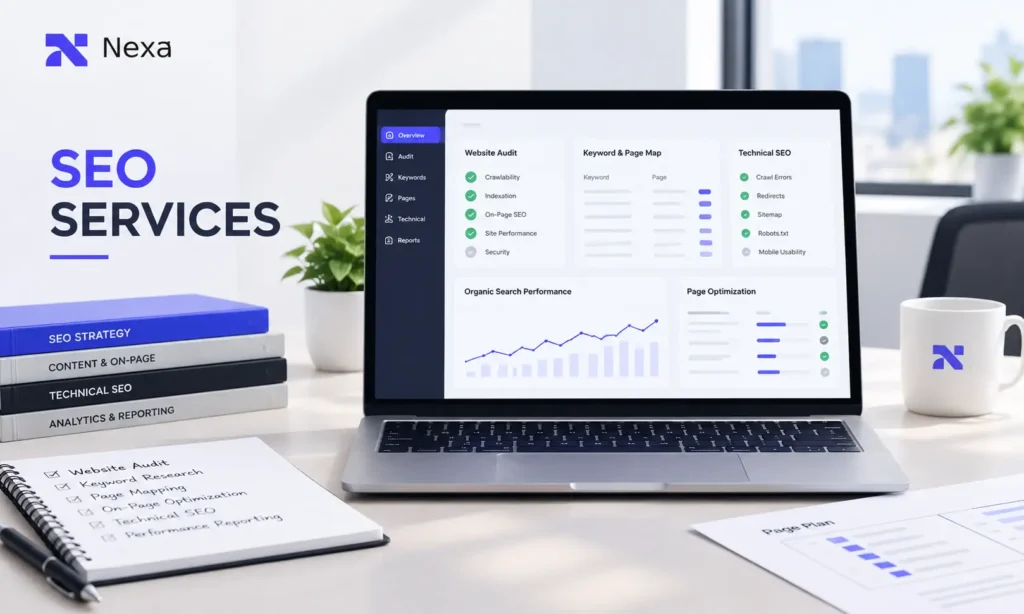
Hiring an SEO agency involves more than choosing a package or agreeing on a monthly fee. You need to understand what work will be completed, which improvements your website actually needs, what deliverables you should receive, and how progress will be measured.
So, what do SEO services include? A typical SEO engagement may cover website audits, keyword research, on-page optimization, technical SEO, content improvements, link building, and performance reporting. The exact scope depends on your website, competition, target audience, business goals, and agreement with the provider.
For businesses in Pakistan, the most useful approach is to evaluate SEO services by their actual work and deliverables—not simply by the number of keywords, backlinks, or activities listed in a proposal.
What Do SEO Services Include?
SEO services help businesses improve their visibility in organic search results and make their websites more useful to potential customers. The work generally falls into several connected areas.
- SEO audits: Identify technical problems, content gaps, and opportunities for improvement.
- Keyword research: Understand what potential customers search for and which topics are relevant to the business.
- On-page SEO: Improve page titles, headings, content, internal links, and page relevance.
- Technical SEO: Address issues affecting crawling, indexing, site structure, and website performance.
- Content optimization: Improve existing pages or plan useful new content around customers’ needs.
- Off-page SEO: Support website authority through relevant mentions and appropriate link acquisition.
- Performance tracking: Monitor search visibility, website activity, and relevant business actions.
Not every engagement needs all these activities at the same time. A website with important indexing problems may need technical work first, while a business with a technically sound website may benefit more from improving its service pages and content.
Nexa Digital Marketing’s SEO services in Pakistan cover these main areas, with work planned around the website, audience, and business goals.
1. SEO Audits and a Prioritized Action Plan
An SEO audit helps establish what needs attention before you invest in further optimization.
Instead of making changes based on assumptions, an SEO provider should review the website’s current condition and identify issues that could affect search visibility or the visitor experience.
Depending on the website, an audit may examine:
- Important pages and their organic search performance.
- Crawling and indexing problems.
- Duplicate URLs, redirects, canonical tags, and XML sitemaps.
- Page titles, headings, content quality, and internal links.
- Mobile usability and website performance.
- Missing content and keyword opportunities.
- Competitor coverage for relevant customer searches.
The important deliverable is not just a long list of errors. You should receive findings that explain what needs attention, why it matters, and what should happen next.
For example, an audit might identify a key service page that is difficult to discover through internal links. The next step could be to improve the website structure and add relevant links from related pages.
A useful action plan prioritizes problems according to their likely impact, implementation requirements, and business relevance. Not every warning from an SEO tool needs immediate attention.
For a deeper explanation of this process, see Nexa’s SEO audit guide for Pakistani businesses.
2. Keyword Research and Page Mapping
Keyword research helps a business understand how potential customers search for its products or services.
However, collecting a list of popular keywords is only part of the job. An effective strategy also considers the reason behind each search and the kind of page that would best answer it.
An SEO provider may investigate:
- Service-related searches from potential customers.
- Informational questions that arise before a purchase.
- Local searches relevant to the business’s service area.
- Competitor keyword gaps.
- Relevant topics that existing pages do not adequately cover.
- Overlapping pages that may target the same search intent.
The next step is keyword mapping: assigning relevant search topics to appropriate website pages.
Consider a Pakistani web development company. Someone searching for a website development service may need a commercial service page, while someone researching website development costs may need a detailed educational article.
Combining both topics into one page may not serve either visitor particularly well. A page plan helps determine which information belongs where and how the pages should connect.
A useful keyword research deliverable should identify target topics, suitable page types, search intent, and the role each page plays in the website’s content structure.
The goal is not to create a separate page for every keyword variation. It is to give important pages distinct purposes and avoid unnecessary duplication.
3. On-Page SEO and Content Optimization
On-page SEO improves the information and structure of individual website pages so they communicate their purpose clearly to visitors and search engines.
This work may include:
- Improving page titles and meta descriptions.
- Organizing headings logically.
- Making service descriptions clearer and more complete.
- Addressing important customer questions.
- Improving internal links and descriptive anchor text.
- Reviewing image descriptions where they help users.
- Aligning content with the intended search.
- Updating information that has become outdated or incomplete.
For example, a service page might list the name of a service without explaining what it includes, whom it suits, or what a customer should expect. Adding those details can help visitors make a more informed decision.
Content optimization does not always mean writing a new article. Sometimes, improving an existing page is more useful than publishing another one.
A provider should assess whether the current content has gaps, serves the wrong search intent, or repeats information already available elsewhere on the site.
Where a business needs a broader content plan, Nexa’s content marketing and strategy service may also be relevant.
4. Technical SEO and Website Performance
Technical SEO focuses on whether search engines can access, understand, and process the important pages of a website.
A technically sound website gives useful content a better foundation, although technical improvements alone do not guarantee higher rankings.
Depending on the audit findings, technical SEO may include the following work.
Crawling and indexing: Check whether important pages are accessible and eligible for indexing, and investigate why valuable pages may be missing from search results.
Website structure: Review navigation, URL structure, internal links, and the organization of important pages.
Redirects and duplicate pages: Identify avoidable redirect problems and clarify preferred page versions where necessary.
Mobile usability and Core Web Vitals: Investigate performance and usability problems that affect the experience of visitors.
Structured data: Add or correct suitable schema markup when it accurately represents the visible page content and meets relevant requirements. Structured data does not guarantee a special search appearance.
Sitemaps and robots.txt: Check whether these files are configured appropriately for the website’s needs.
A technical SEO provider should explain which issues require action and which have little practical importance in the website’s current situation.
Some fixes can be made through the website’s content management system, while others may require developer assistance. Confirm who will implement the work before the project begins.
Read Nexa’s guide to Technical SEO in Pakistan for more information. If loading performance is a concern, the company’s Website speed optimization guide is a useful related resource.
Google’s Core Web Vitals documentation explains how loading performance, responsiveness, and visual stability are measured. These metrics should be considered alongside the wider user experience, not treated as the only measure of SEO quality.
5. SEO Content and Existing-Page Improvements
Businesses often assume that SEO requires publishing articles continuously. In practice, the right approach depends on what the website already contains and what its audience needs.
SEO content work may involve:
- Improving existing service and product pages.
- Updating information that is no longer accurate.
- Filling important gaps in explanations or supporting resources.
- Planning articles around genuine customer questions.
- Improving page organization and readability.
- Connecting related pages through contextual internal links.
- Consolidating overlapping content when appropriate.
Imagine an online store with useful product pages but category descriptions that provide little information. Improving the category pages and their internal links may be more appropriate than publishing several general articles about the products.
Similarly, a service business might need better explanations of its individual services before investing heavily in a blog.
A content recommendation should explain why a page is needed, what question it answers, and how it supports the wider website. More content is not automatically better content.
6. Off-Page SEO and Link Building
Off-page SEO involves activities outside your website that can support discoverability and reputation.
Link building is one part of this work. It focuses on earning relevant links from other websites that provide value to users and help people discover useful resources.
Depending on the strategy, activities may include:
- Creating resources worth referencing.
- Relevant outreach to publishers or website owners.
- Earning editorial mentions.
- Identifying relevant industry or local opportunities.
- Reviewing the quality and relevance of existing backlinks.
For a Pakistani business, the right opportunities depend on its industry, audience, resources, and target market. A local service business and an international eCommerce company may need different approaches.
Do not judge a provider solely by a promised number of backlinks. Ask how the links will be acquired, whether the sources are relevant, and what risks the proposed method could create.
Google’s Spam policies explain practices that can violate its guidelines, including link schemes intended to manipulate search rankings.
A responsible strategy prioritizes relevance and legitimate value rather than bulk link placements or automated schemes.
7. Local SEO for Businesses Serving Pakistani Customers
Local SEO may be important when customers search for services in a particular city or area.
For eligible businesses, this work can include improving their Google Business Profile, ensuring business information is accurate, strengthening relevant location pages, and maintaining consistency across useful business listings.
For example, a business serving customers in Lahore may need a clear service page, an accurate Business Profile where eligible, and useful information about its actual service area.
A company operating nationally may have different needs. It should not create nearly identical location pages for cities it does not genuinely serve.
Local SEO may include:
- Reviewing business name, address, phone number, and opening information where applicable.
- Checking Business Profile categories and service details.
- Improving relevant location and service pages.
- Reviewing business listings for inconsistencies.
- Monitoring relevant local searches and customer actions.
Google explains local results through factors including relevance, distance, and prominence in its Local ranking guidance.
Local SEO is not necessary in the same form for every business. Its scope should reflect how customers find and use the company’s services.
8. SEO Reporting and Performance Tracking
Reporting helps you understand what has been completed, what the available data shows, and which decisions may be appropriate next.
A useful SEO report should go beyond a screenshot showing a few keyword rankings.
Depending on the project and tracking setup, reporting may include:
- Work completed during the reporting period.
- Search impressions and clicks.
- Relevant queries and the pages appearing for them.
- Changes in organic traffic to important landing pages.
- Outstanding technical problems.
- Content updates and implemented recommendations.
- Enquiries, form submissions, purchases, or other tracked actions.
- Priorities for the next stage.
Google Search Console helps website owners monitor performance in Google Search. Its reports include metrics such as clicks, impressions, click-through rate, and average position. Learn more in the official Search Console performance report documentation.
Google Analytics 4 can complement this information by helping assess website activity and configured events. Important business actions can be tracked as key events when analytics is set up correctly. Google’s GA4 key events documentation explains this measurement.
These tools answer different questions. Search Console provides insight into how a site appears in Google Search, while Analytics helps show what visitors do after reaching the site.
For instance, a service page might receive more organic visits without generating more enquiries. That is a reason to investigate visitor relevance, page clarity, calls to action, and the enquiry process—not simply to assume that the SEO campaign has succeeded or failed.
What Should You Receive From an SEO Agency?
The precise deliverables vary by provider and project scope. Before an engagement starts, ask for a written description of the work and how it will be delivered.
A practical SEO services checklist includes the following.
Initial assessment
- A review of the website’s current condition and relevant performance data.
- An audit or assessment appropriate to the website’s needs.
- A keyword and page strategy.
- A prioritized list of recommended improvements.
Implementation and content
- A clear list of pages or website areas to be optimized.
- Details of technical changes and who will implement them.
- Content updates, briefs, or new content agreed upon in the scope.
- An internal linking plan where relevant.
- An explanation of any planned off-page activities.
Reporting and communication
- An agreed reporting frequency.
- Access to relevant reports and data.
- A record of completed work and outstanding tasks.
- Clear explanations of progress, problems, and next steps.
Ownership and responsibilities
- Clear arrangements for website, hosting, analytics, and Search Console access.
- Agreement about who approves content and technical changes.
- Clarification of who owns commissioned content and other project assets.
- A handover process if the engagement ends.
Not every provider supplies every deliverable as part of every package. The aim is to agree on a realistic scope before work begins, rather than assume that a service name automatically includes every possible activity.
SEO Packages in Pakistan: What Should You Compare?
When comparing SEO packages in Pakistan, avoid making the decision solely on price or the number of keywords included.
Two packages may use similar labels while covering very different amounts of research, implementation, content work, and reporting.
Instead, compare the following factors.
Scope of work: Which pages and technical areas will be addressed? Is the work limited to recommendations, or will the provider implement approved changes?
Content requirements: Does the engagement include writing new content, editing existing pages, or only providing recommendations?
Technical resources: Who will handle development work if the website needs changes to its structure, templates, or code?
Link building: What methods will be used, and how will the relevance and quality of the work be assessed?
Reporting: Which metrics will be reviewed, how often will you receive updates, and what decisions will the reports support?
Business fit: Does the proposed strategy match the website’s size, competitive environment, audience, and goals?
The right scope for a small local business may be very different from the right scope for a large online store or a company competing across Pakistan.
Nexa Digital Marketing describes its SEO plans as being based on website size, competition, and business goals. You can Explore our SEO services to understand the work we offer.
For businesses with broader marketing requirements, the Small business digital marketing guide provides additional context about how SEO fits into a wider marketing approach.
Questions to Ask Before Hiring an SEO Agency
Before agreeing to an SEO engagement, ask the provider a few direct questions.
- What work will you complete, and what will I receive?
Ask for specific deliverables rather than a general promise to improve rankings.
- Which issues will you address first, and why?
The provider should be able to connect priorities to your website’s actual condition and business objectives.
- Who will implement technical changes?
Clarify whether development work is included, handled separately, or assigned to your own team.
- How will you measure progress?
Understand which search and business metrics will be reviewed and whether conversion tracking is configured appropriately.
- What is outside the agreed scope?
Ask about content production, paid tools, development, outreach, and other activities that may require additional resources or approval.
- How will website access and ownership be handled?
Make sure the business can retain appropriate access to its website, analytics, and relevant accounts.
These questions help you compare providers on the actual service rather than relying on package names or sales promises.
How Long Does SEO Take to Work in Pakistan?
There is no single timeline that applies to every website.
Some technical issues can be identified quickly, while larger improvements to content, authority, and organic visibility may require sustained work and repeated evaluation.
The timeframe can depend on the website’s starting condition, competition, search demand, implementation speed, content requirements, and available resources.
A useful provider should explain what can be addressed first, which changes depend on other teams, and how progress will be monitored. They should not guarantee a particular ranking or exact number of leads by a fixed date.
Rather than judging the engagement against an arbitrary deadline, review whether the agreed work is being completed and whether the available evidence supports the next decisions.
Key Takeaways Before Hiring an SEO Agency
Understanding what SEO services include helps you make a better decision about where to invest your time and budget.
A useful SEO engagement may involve audits, keyword research, on-page and technical improvements, content optimization, link building, local SEO, and reporting. The right combination depends on your website, audience, competition, and business goals.
For businesses in Pakistan, the key is to understand exactly what the provider will do, what you will receive, how implementation will be handled, and how progress will be assessed.
If you are reviewing your website’s organic search performance, explore Nexa Digital Marketing’s SEO services in Pakistan to learn about its approach. You can discuss your website, priorities, and business goals before deciding which SEO work is appropriate.
Frequently Asked Questions
1. Are all SEO services included in every package?
No. The scope depends on the provider and agreement. Some projects focus on audits or specific improvements, while ongoing engagements may cover technical work, content, link building, and reporting. Confirm the inclusions and exclusions before starting.
2. Is SEO a one-time service or an ongoing process?
It can be either, depending on the need. A one-time audit can help identify problems and priorities, while ongoing work may be suitable when a business needs continuing content improvements, technical maintenance, and performance reviews.
3. What should an SEO report include?
A useful report explains completed work, search impressions and clicks, relevant page performance, outstanding issues, and next steps. Where appropriate tracking is configured, it may also include enquiries or other important business actions.
4. Does every business need local SEO?
No. Local SEO is particularly relevant to businesses that serve customers within specific geographic areas. A business targeting a national or international audience may need a different emphasis. The strategy should match how its customers search.
5. Can an SEO agency guarantee first-page rankings?
A responsible provider should not guarantee a particular Google ranking. Search visibility depends on multiple factors outside any provider’s complete control. Evaluate the plan, implementation, reporting, and quality of work rather than accepting guaranteed-ranking claims.
6. How can I tell whether an SEO package is suitable for my business?
Check whether the proposed work addresses your website’s actual needs, whether deliverables and responsibilities are clear, and whether reporting connects activities to meaningful outcomes. Compare the scope and implementation arrangements before comparing prices.